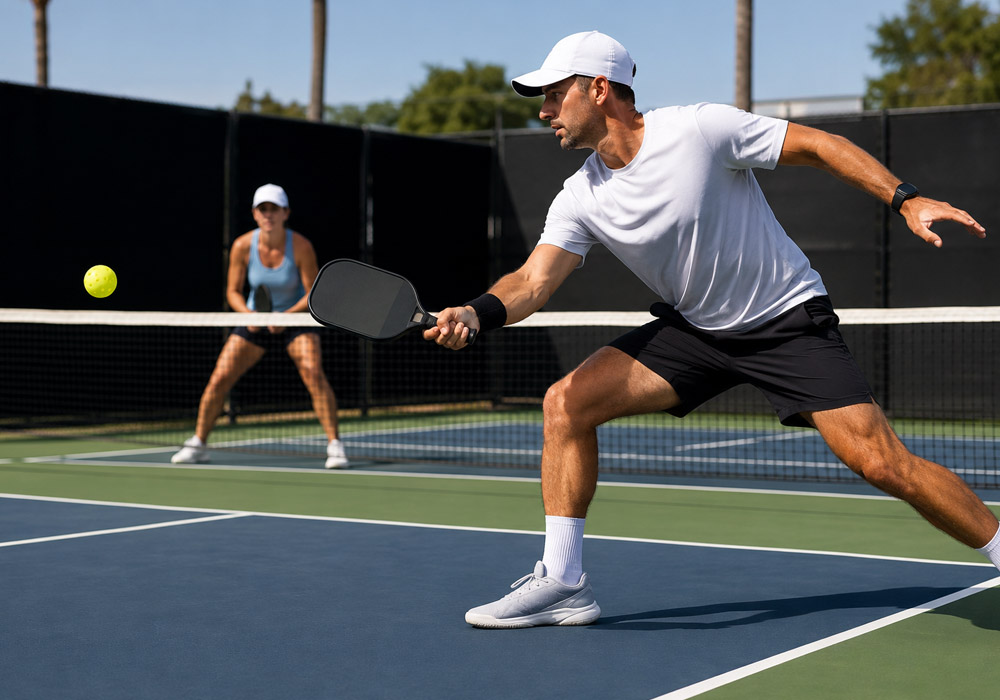
In the past, pickleball did not favor powerful shots. If we go back five years, the right strategy was to play at a slower pace, hit soft shots, and patiently wait for the opponents to commit errors. This style of play still persists, however, it is not the only way to play anymore. The paddles that are currently being developed illustrate a game that is divided into two conflicting strategies: strike the ball hard and take the initiative, or dominate the rally and allow your opponent to err.
The game changed faster than most players noticed
If you watch any competitive game right now, you’ll see ATP winners fired from the transition zone, full-swing overheads on anything that floats, and hand battles at the net faster than the eye can cleanly track. None of that was acceptable even a season or two ago. Third-shot drops used to level the playing field – now they’re just the first shot before a speed-up war.
Some of this is easy mathematics. Pickleball participation increased from 4.8 million players in 2021 to 8.9 million in 2022, an 85.7% increase that made it the country’s fastest-growing sport for the third consecutive year (SFIA). More players mean more styles collide, and more athletes bring tennis and racquet-sport backgrounds into a game that used to be dominated by finesse players. The result is a faster, harder, more aggressive baseline meta – and paddle manufacturers have spent the last three years chasing it.
Face material tells you where the arms race is headed
The most obvious proof of the power and control revolution is that most of the best paddles in the game no longer have faces made of graphite, the dreamy wonder-material of courtsport equipment. Graphite began replacing fiberglass as a high-end paddle face for a simple reason: it’s lighter. Lighter means faster reaction times. But carbon fiber has since taken over at the top of the market, with most premium paddles now built around T700 Toray carbon or similar high-modulus weaves. Each generation trades a little bit of touch for a stiffer, more explosive response off contact.
Graphite still shows up on a lot of mid-priced paddles, and it’s not obsolete – it gives a slightly softer feel that some control players still prefer. But carbon has become the default at the top because it holds up better under repeated hard contact and gives players a more consistent response even when they’re swinging aggressively. If you’re testing paddles side by side, the face material is usually the fastest tell for whether something was built for bangers or dinkers. Rather than guessing from marketing copy, a lot of players now cross-reference face material, core thickness, and swing weight using a pickleball paddle database before deciding whether a paddle actually matches their game or just matches the trend.
The quieter story is what’s happening to the surface itself. Rough, grit-textured faces let players brush the ball and generate spin without sacrificing pace, which matters a lot when you’re trying to control a ball you’re also hitting hard. The problem is that grit wears down with use, which is why more brands are shifting toward etched or 3D-molded textures baked into the carbon layer instead of a sprayed-on coating. It’s a durability fix, but it’s also a performance one – a paddle that loses its texture halfway through a season is a paddle that quietly loses spin control right when a player has gotten used to relying on it.
Core thickness is the real dividing line
If the face material is the outer story, the honeycomb core is the internal story, and at 13-16mm thick, it’s the thickest part of the paddle. The core serves as the underlying structure of the paddle face and helps determine the overall feel and performance of the paddle.
Thinner cores (13-14mm) have less give, so when the ball makes contact with the paddle face, the core doesn’t compress as much, resulting in less energy lost back to the ball and a quicker response off the face. Thinner cores are often favored by players looking for more power since they offer more “pop” and result in a faster-moving ball. However, the looser structure can give players less control.
Thicker cores (16mm and up) allow for more compression on ball contact, which equals more energy transfer back to the ball and a slightly slower ball speed off the paddle face. The extra compression creates a longer “dwell time,” or how long the ball is in contact with the paddle face. This gives players more time to direct the ball and the paddle face during ball contact. Thicker cores often provide a softer, more dampened feel, which many control players or casual players prefer. Most recreational paddles are still built with 16mm+ thick cores for this reason.
Shape decides how much of that power you can actually use
The core and face get all the glory, but in truth, the shape is what quietly decides whether that “power” paddle you just bought is actually any good for your game. Elongated shapes lengthen the paddle face, giving you extra reach. They also stretch the “power zone” – that spot on the paddle where you can feel the hit travel into the ball – letting you get your full weight and swing behind a drive you’re hitting off your front toe because you’re reaching. The costs are a smaller sweet spot and slower hand speed, which doesn’t matter when you’re winding up for the winner but becomes a game killer in the fast exchanges at the net.
Widebody and hybrid shapes give up some of that reach for a broader face and a sweet spot where the perfect hit isn’t the sixteenth of an inch in the middle of the paddle. They’re designed for the player whose game is about taking the ball off the bounce two inches in from the net, where double-hops and caroms off the corner of the paddle are part of every point. Neither shape is objectively better. An elongated paddle in the hands of a control player is a mismatch, and a widebody in the hands of a baseline banger just shortens their reach without giving them anything back.
The numbers that actually predict how a paddle feels
This is the part where many people are led astray: the indicated weight on a paddle is virtually useless for estimating what it plays like in a rally. The swing weight – measured in g·cm – is the relevant number for that, because it takes into account how the mass is distributed, not just how much of it there is. A 7.8oz paddle with a handle-heavy balance can go through the air more quickly than a 7.0oz paddle that’s been loaded up near the head. Head-heavy paddles have more inertia moving into the ball, which is why power players are often drawn to them despite the fact that the static weight might be equivalent to a lighter choice.
Another feature that often goes unnoticed until it’s too late is twist weight. This metric tells you how much a paddle will twist in your hand when you hit the ball off-center – which is pretty much every shot in every game of pickleball you’ll ever play. A high twist weight will keep those off-center power drives true and minimize your opponent’s ability to capitalize on your off-center blocks at the net. Push it too far though, and it will limit the quick hand adjustments needed in fast exchanges. You can tell pretty quickly if a paddle has too much twist weight – it will feel clunky and borderline unplayable when defending at the net, as you struggle to make those quick-fire reaction blocks when your opponent changes the angle and speed of their shots.
It’s all about balance point. Head-heavy paddles give you a bit of free power on drives and overhead shots while requiring a little more work to adjust for those delicate shots at the net. Handle-heavy paddles are almost the opposite; they make it feel light and easy on quick shots at the net but give up some momentum on drives. Don’t make the mistake of blaming or crediting your paddle for your successes and failures, but don’t underestimate the impact technology can have on your performance either.
Manufacturing and regulation are shaping the ceiling, not just the floor
There are limits to this power chase. The USA Pickleball Approved List dictates how rough, stiff, and thick a face can be for sanctioned play, thus determining that the “arms race” isn’t about who can make the most powerful face, but who can win with the constraints in place. This has led to better material layering and weight distribution, producing paddles with a lot of pop while staying under the approved limits.
Thermoformed and unibody construction highlights this best. By molding the face and frame into a single piece, the edge is hardened, weak points are reduced, the paddle’s lifespan is extended, and you get a firmer, more explosive response, all while staying in the allowable limits. It is no accident that thermoformed paddles have become the premium category, typically costing somewhere between $180 and $250. Conversely, mid-range graphite paddles are doubling down on control positioning, as that is actually where the majority of the recreational market lives. Not everyone buying a paddle is trying to out-hit their opponent.
Match the tradeoff to your actual game
None of the technobabble going on with “the latest model” will meaningfully improve your play in the short run if you don’t have the right fundamentals. A player with a kink in his stroke can’t fix it by adding a half-inch of reach to his paddle, no matter how gleaming the weave. Implied promises that more over-this and under-that will be your game-changer are usually trying to distract you from the fact that you are the most important variable, and that the return on investment from gear flowing from a sound game is invariably better than the other way around.
Overall, pickleball has exploded in popularity across America becoming one of the fastest-growing sports in recent years. Its easy learning curve and social appeal draw players of all ages. Therefore, enjoying the game fully requires the right equipment to elevate your skill level, enhance performance, prevents injury, and keeps the fun going.