Key Takeaways
- Emergency skills can become less automatic when they are not used or practiced regularly.
- Brief, recurring reviews can build confidence, improve communication, and enable faster team coordination.
- Scenario-based drills help reveal practical gaps that written tests may not identify.
- Online learning is useful for reviewing knowledge, while hands-on practice remains important for physical skills and equipment use.
- Healthcare workers should monitor credential renewal dates, employer requirements, and local emergency policies.
- Readiness depends on repetition, clear roles, respectful feedback, and a shared response plan.
Emergency readiness is not something healthcare workers achieve once and then set aside. In a clinic, dental office, long-term care facility, outpatient center, or hospital unit, a serious breathing or cardiac emergency may be uncommon, but the need for a calm response can arise without warning. Keeping core skills current helps staff move from recognition to action with less hesitation.
A formal renewal course is an important starting point, and an online BLS recertification option may help busy professionals review required material around demanding schedules. Still, a completion record alone does not replace the regular practice needed to use equipment, communicate with coworkers, and perform role-specific tasks under pressure.
Why Emergency Skills Need Regular Practice
Knowing the steps of an emergency response is different from carrying them out in a crowded room while other people are asking questions, locating supplies, and calling for help. Skills that rely on timing, positioning, equipment handling, and teamwork benefit from repeated rehearsal. Regular refreshers give workers a chance to recall the response sequence before a real event raises the stakes.
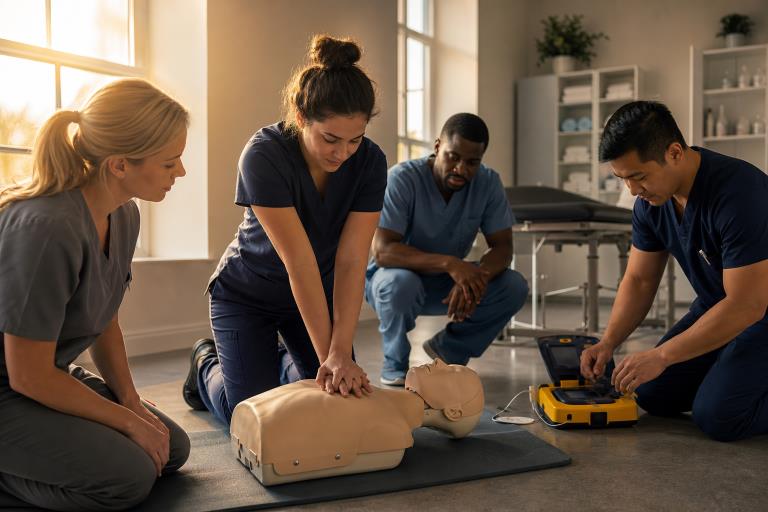
Consider a patient who suddenly collapses in a busy clinic waiting area. One staff member must assess the situation, another may bring the AED, and another may contact emergency services or guide responders to the correct entrance. Practice makes it easier for each person to recognize the next priority rather than waiting for someone else to take the lead.
What Skills Should Stay Fresh?
The specific skills required depend on a worker’s job, setting, patient population, and employer policies. However, many healthcare teams benefit from routinely reviewing the following areas:
- Adult, child, and infant CPR fundamentals are appropriate to the worker’s training level.
- Automated external defibrillator setup and use.
- Recognition of cardiac and breathing emergencies, plus the process for activating help.
- Choking care and basic first aid responsibilities.
- Bag-mask ventilation and other techniques are assigned to trained clinical personnel.
- Scene checks, closed-loop communication, documentation, and equipment retrieval.
Build a Simple Skills-Refresh Plan
A practical plan does not need to take hours every week. Short, focused sessions are often easier to schedule and can help staff identify weak points early. Consider using this cycle throughout the year:
- Check the expiration date for every required credential.
- Review the emergency policies and escalation procedures used at the workplace.
- Reserve a short monthly block for one core skill or response sequence.
- Use skill cards, brief quizzes, or a checklist to review essential actions.
- Participate in team drills when they are available.
- Record questions or weak areas after each practice session, then address them at the next review.
Use Scenario-Based Practice
Written tests can confirm knowledge, but realistic scenarios show how people work together. A simulated patient collapse, choking event, or child with breathing trouble can expose issues such as unclear role assignments, missing equipment, poor handoffs, or uncertainty about whom to call. These are operational problems that may not appear during an individual study.
Role-play also lets nurses, physicians, technicians, front-desk staff, and support personnel practice their responsibilities as one team. A recent Veterans Affairs program used quarterly on-site mock codes and simulation training to help staff rehearse protocols, teamwork, documentation, and equipment use. Small practices can adapt the same principle with a simple written scenario and a short debrief.
Balance Online Learning With Hands-On Work
Online modules can be especially useful for reviewing concepts, response sequences, terminology, and policy updates at a flexible pace. They can also help learners arrive at an in-person session better prepared to ask questions and focus on the skills that need the most attention.
Hands-on work remains valuable because physical tasks require more than recall. Learners may need feedback on compression technique, body position, bag-mask use, and AED operation. Newer training formats increasingly combine self-paced digital coursework with skills verification. In March 2026, the American Heart Association described a nationwide model that pairs online learning with a self-guided, technology-supported hands-on skills session as part of its resuscitation learning model.
Keep Training Aligned With Current Guidance
Resuscitation and first aid guidance can be updated as evidence, systems of care, and education practices develop. Healthcare workers should rely on current official course materials and reputable professional organizations rather than outdated notes, informal social media posts, or procedures learned in a previous job.
Workplace rules can also differ by state, employer, department, and patient population. Confirm which credentials are required, whether an in-person skills check is necessary, and which emergency protocols apply in your specific setting. When guidance changes, update checklists, training materials, and team expectations together.
Track Renewal Dates Before They Become Urgent
Missing a renewal deadline can create avoidable scheduling stress and may affect eligibility for assigned duties. Set calendar reminders several months before each credential expires, then add a second reminder closer to the date. Keep completion records in a secure digital location, and retain printed copies when your employer requests them.
If requirements are unclear, ask a supervisor, educator, or credentialing contact well before the deadline. This is particularly important for staff who hold multiple credentials or work across multiple facilities.
Make Emergency Readiness a Team Habit
No single person can manage every part of an emergency response alone. Before an event occurs, teams should know who brings emergency equipment, who calls for outside help, who meets responders, who documents events, and who takes clinical leadership when appropriate. Clear roles reduce duplication and confusion.
After a drill or real emergency, hold a short, respectful debrief. Discuss what worked, what caused delays, and what should change next time. The goal is learning, not blame. Even a five-minute conversation can lead to a clearer checklist, better equipment placement, or a needed skills refresher.
Conclusion
Emergency readiness is built through steady practice, not a single class or test. By reviewing core skills, tracking renewals, taking part in realistic drills, and strengthening team communication, healthcare workers can be better prepared to provide a fast, calm, coordinated response when a patient needs help.