
$11,800. That’s what it cost the average retail mortgage lender to produce a single loan in Q2 2025, according to Freddie Mac’s 2025 Cost to Originate update. And that number has been climbing for years. Average loan origination costs rose 35% between 2021 and 2024. If you’re running a brokerage and that trend hasn’t forced a serious look at your technology stack yet, it’s about to.
The mortgage industry is not exactly famous for fast pivots. But something genuinely different is happening with AI right now, and the brokerages taking it seriously are building real, durable cost advantages over those still running on spreadsheets, sticky notes, and manual condition chasing. This piece breaks down where AI actually fits in a modern brokerage’s workflow, what to buy versus what to build, and how to think about the rollout so you don’t end up with expensive software nobody uses.
The Cost Problem That Makes AI Urgent
To understand why so many shops are moving fast on AI right now, you need to look at the margin picture clearly. The average cost to produce a mortgage in Q2 2025 was approximately $11,800, still roughly $200 higher than the Q3 2023 period. Meanwhile, Q1 2024 marked the eighth consecutive quarter of net production losses for many lenders, with the average lender facing a net loss of $645 per loan. That’s not a revenue problem. It’s an efficiency problem. And efficiency problems respond to technology.
The Freddie Mac 2024 Cost to Originate Study showed that origination costs have risen 35% over the past three years, with the top 25% of performers averaging a cost-per-loan of $6,900 compared to $16,500 for the bottom 25%. The gap between the most efficient shops and the least efficient ones is not a little different. It’s 2.4 times the cost per loan. That gap is where technology decisions live.
| Performance Tier | Avg. Cost Per Loan (2024) | AI/Automation Adoption Rate
|
| Top 25% of lenders | $6,900 | High (digital-first workflows) |
| Industry average | ~$11,800 (Q2 2025) | Moderate |
| Bottom 25% of lenders | $16,500 | Low (manual-heavy) |
Sources: Freddie Mac 2024 Cost to Originate Study; Freddie Mac 2025 update.
Where Adoption Actually Stands
The growth numbers here are striking. According to a 2025 survey by Stratmor Group, 38% of mortgage lenders in 2024 reported using artificial intelligence and machine learning, up from 15% in 2023. That’s more than a doubling in twelve months. The same survey noted that 48% of lenders used robotic process automation in the past year to handle processes like ordering appraisals and credit scores, up from 30% in 2020.
For context, this is still the early-adopter phase. More than 60% of lenders haven’t meaningfully integrated AI yet. That’s actually great news if you’re reading this now, because the window to get ahead of the curve without being the reckless first-mover is still open. Barely, but open.
“Mortgage lenders are increasingly investing in automation and AI as foundational technologies to improve efficiency and productivity. This represents a fundamental transformation in how mortgage operations are being conducted.”- That’s Nicole Yung, Senior Partner at Stratmor Group, writing in the firm’s April 2025 Technology Insight Study. Yung’s framing is deliberate: she calls it foundational, not supplemental. That distinction matters for how you budget for it.
The Three Places AI Moves the Needle Most
Not every AI product is worth your time. The mortgage workflow has dozens of steps, and AI isn’t equally useful across all of them. Based on where the documented efficiency gains are largest, three areas stand out.
- Document processing and income calculation. This is where AI earns its keep fastest. Reading pay stubs, W-2s, tax returns, and bank statements is tedious, error-prone, and constant. AI can extract, categorize, and cross-reference that data in seconds. AI in mortgage drives up to a 50% increase in mortgage origination volume and helps close mortgage deals 2.5 times faster than the industry average. Gains that size don’t come from better email templates. They come from removing the manual document review bottleneck.
- Condition resolution. This one is underappreciated. After an underwriter issues conditions, somebody has to read every single one, figure out what document fixes it, track down the client, and confirm the submission is correct. That loop eats hours per file. AI can read AUS findings and condition lists, match them against what’s already in the file, and draft the exact document request to the borrower. That’s not a marginal improvement. That’s a different workflow.
- Client-facing communication. Borrowers want updates. They text at 10 PM. They want to know if their file is moving. An AI agent can handle routine status inquiries and document reminder requests around the clock without putting that burden on your loan officers. This is where platforms built specifically for lending workflows, including AI agents for mortgage brokers, have built purpose-trained agents that handle document requests and borrower communication without human hand-holding.
A Framework for Evaluating Any AI Tool: The CRIT Test
The market is flooded with software vendors claiming AI capabilities. Some of them mean it. Many of them have bolted a chatbot onto a legacy system and called it AI. Before you sign anything, run every tool through what I think of as the CRIT test.
- C: Connected to your LOS? An AI tool that doesn’t sync with your Loan Origination System creates double-entry work and defeats the purpose. Integration is non-negotiable.
- R: Reasoning or just retrieval? A tool that retrieves stored answers is a fancy FAQ. A tool that reasons over a document and identifies what’s missing is actually useful for mortgage work.
- I: Industry-trained or general purpose? A general-purpose large language model does not know Fannie Mae guidelines. A model fine-tuned on mortgage data does. The difference in accuracy is large enough to matter in a compliance context.
- T: Trainable on your data? Your lender relationships, rate sheets, and internal guidelines are competitive assets. The best AI platforms let you train agents on those specifics so the output reflects your shop, not a generic average.
If a vendor can’t answer all four cleanly, move on. There are enough serious players in this space now that you don’t need to compromise on basics.
What the Rollout Actually Looks Like
The implementation failure mode I see most often isn’t picking the wrong software. It’s picking decent software and rolling it out without a change management plan. Forward-thinking organizations are moving beyond basic automation to develop digital strategies that enhance rather than replace human expertise, with the most effective strategies focusing on automating repetitive tasks while redirecting human capital to high-value client interactions. That’s the right framing, and it needs to be communicated to your team clearly before anything goes live.
Here’s a practical rollout sequence that avoids the most common failure points.
- Audit one workflow first. Pick the single most painful manual task in your current process, usually document collection or condition chasing, and deploy AI only there. Do not try to automate everything at once.
- Run parallel for two weeks. Have a processor handle the workflow both ways simultaneously and compare outputs. This builds trust in the AI’s accuracy and surfaces edge cases before they become production problems.
- Set accuracy benchmarks before going live. Define what “good enough” looks like in writing. For income calculation, that might mean 99% accuracy on tax return extraction. Know your threshold.
- Get the LOS integration working before training the team. Nothing kills adoption faster than a tool that requires manual data re-entry to work. Solve the integration problem first.
- Train on your specific guidelines, not general ones. Every lender relationship you have comes with quirks. Feed those to the AI, so it learns your actual workflow, not a textbook version of one.
The Competitive Math Is Getting Harder to Ignore
The mortgage brokerage industry is projected to grow at a compound annual growth rate between 7% and 10.2% from 2025 through 2033, potentially reaching a market size of $250 billion. Adoption of advanced technologies including artificial intelligence and automated underwriting systems represents the primary factor shaping these growth forecasts, and brokerages that successfully integrate these technologies will likely capture disproportionate market share.
Read that last part carefully. Not “all brokerages will benefit equally.” Disproportionate market share goes to the ones who move. That’s the bet you’re making when you decide to wait another year.
Lenders who proactively adopt AI can gain a significant competitive advantage, improving their operational efficiency, customer service, and risk management. This isn’t theoretical at this point. The Stratmor data shows the efficiency gap between the top quartile and the bottom quartile is already $9,600 per loan. Shops running on AI-augmented workflows are not just saving time. They are structurally cheaper to operate, which means they can price more competitively, handle more volume with the same headcount, and survive rate cycles that squeeze out less efficient competitors.
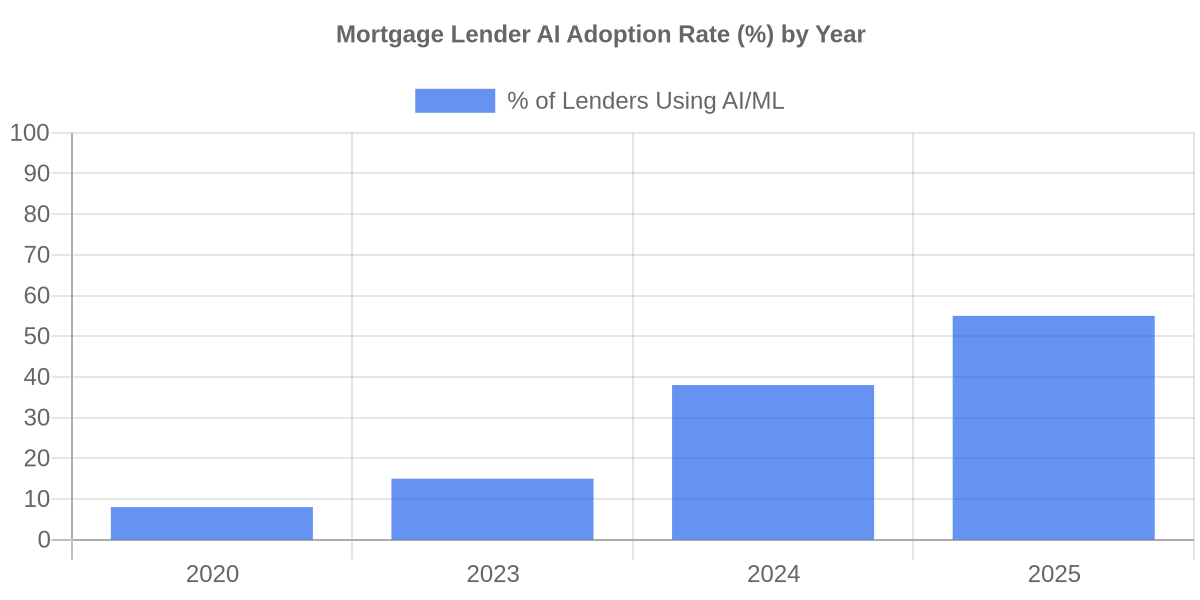
AI/ML adoption among mortgage lenders by year. Sources: Stratmor Group 2025 survey; Fannie Mae 2025 projection. 2020 figure estimated from RPA baseline data.
What You Should Not Automate
This part doesn’t get enough attention. AI is genuinely powerful at high-volume, rules-based tasks. It is not a replacement for judgment-heavy conversations with borrowers who are confused, stressed, or navigating a complex financial situation. That’s still a human job, and it should stay that way.
The brokerages I’d watch out for are the ones using AI as a cost-cutting excuse to reduce human touchpoints at moments that require empathy. The borrower who just had an offer accepted on their first home is not looking for a chatbot. They want a person who knows their file. Use AI to free up your loan officers for those moments, not to eliminate them.
Borrowers in 2025 are prioritizing a certain and speedy mortgage decision, and brokers are relying more on sourcing and criteria tools to provide accurate affordability assessments, understand lender policies, and access real-time property valuations. Speed and certainty are what borrowers want. AI delivers speed. Humans deliver certainty in moments where confidence needs a voice attached to it.
Practical Checklist: Is Your Brokerage AI-Ready?
Before you evaluate a single vendor, run through these eight questions. Honest answers will tell you where your actual gaps are.
- Does your LOS have a documented API? If not, integrations will be painful and expensive.
- Do you have a consistent document naming convention across your team? AI performs better with organized inputs.
- Can you identify your three highest-volume manual tasks by time spent per loan?
- Do your processors have bandwidth to run a two-week parallel pilot?
- Have you documented your lender-specific guidelines anywhere? If they only live in people’s heads, training an AI on them will be hard.
- Do you have a compliance review process for AI-generated borrower communications?
- Are your loan officers open to AI assistance, or will resistance be the real obstacle?
- Do you have a baseline metric, such as days to close or conditions per file, to measure improvement against?
If you answered “no” to more than three of those, your first investment isn’t software. It’s process documentation. Get that done first and the AI rollout will be dramatically smoother.
The Real Question Isn’t Whether. It’s When and How.
The brokerages that will look back on this period as a turning point are the ones that treated AI adoption as an operations strategy, not a tech experiment. As Stratmor’s Nicole Yung notes, “Mortgage lenders are increasingly investing in automation and AI as foundational technologies to improve efficiency and productivity.” Foundational. That word is doing a lot of work. Foundations don’t get ripped out when the market shifts. They compound.
The cost gap between AI-augmented shops and traditional ones is already measurable. It will widen. The question isn’t whether your brokerage will eventually use AI to handle document processing, condition management, and borrower communication. That outcome is settled. The only open question is whether you build that advantage now, while the competitive field is still uneven, or later, when everyone else has already done it. What’s your current cost per loan, and how far is it from $6,900?