Achieving reliable and reproducible analytical results requires the right habits built into every step of your laboratory workflow.
The four most effective habits for perfect lab results are matching column chemistry to the specific method, preventing contamination before injection, running daily system suitability checks, and troubleshooting the method before adjusting instrument hardware.
Implementing these lab accuracy tips prevents costly batch failures, delayed reports, and unexpected re-runs.
Consistently applying these core principles protects data integrity without requiring major capital investments.
1. Match Column to the Method
Stationary phase chemistry, internal diameter, and film thickness must align with the analyte list.
Following basic geometry principles, a thicker film improves early-eluting peak shape by increasing retention for volatile analytes.
A thinner film sharpens late eluters and reduces bleed at high oven temperatures. This deliberate alignment helps reduce testing errors in complex applications like pesticide residue screening.
Beyond initial selection, lot-to-lot consistency is a non-negotiable workflow requirement. In high-throughput environments, column-to-column reproducibility directly dictates whether a batch passes or triggers an investigation.
Many facilities working in environmental monitoring and food safety rely on Restek’s standardized GC columns for this exact reason.
Consistent manufacturing translates directly into predictable performance across long-run sequences.
2. Guard Against Contamination Early
Treat sample preparation and inlet maintenance as critical control points. Worn septa and neglected inlet liners introduce ghost peaks and tailing that mimic detector failure.
Particulate-laden samples and poorly rinsed autosampler vials generate carryover that inflates apparent analyte concentrations.
Standard chromatography best practices dictate centrifuging samples completely before transfer and replacing inlet consumables on a fixed schedule.
Consider a food safety lab running organochlorine pesticide recovery that encounters erratic peak areas.
Often, the root cause is nonvolatile lipid residue accumulating in the inlet liner. By scheduling proactive maintenance, labs can return peak area precision to acceptable levels before contamination impacts reported data.
Specifically, maintaining an RSE acceptance limit of 20% ensures regulatory compliance.
| Important: Neglecting worn septa and dirty inlet liners leads to ghost peaks, tailing, and lost sensitivity. Fix the inlet before suspecting the detector. |
3. Build a Stability Check Rhythm
Daily system suitability trending is the cheapest form of instrument insurance available. Pressures, flow rates, and oven temperatures shift quietly over time due to ambient conditions.
A mere 0.1 mL/min flow rate deviation is enough to compromise retention time reproducibility. These subtle symptoms rarely look dramatic until they cause a batch failure.
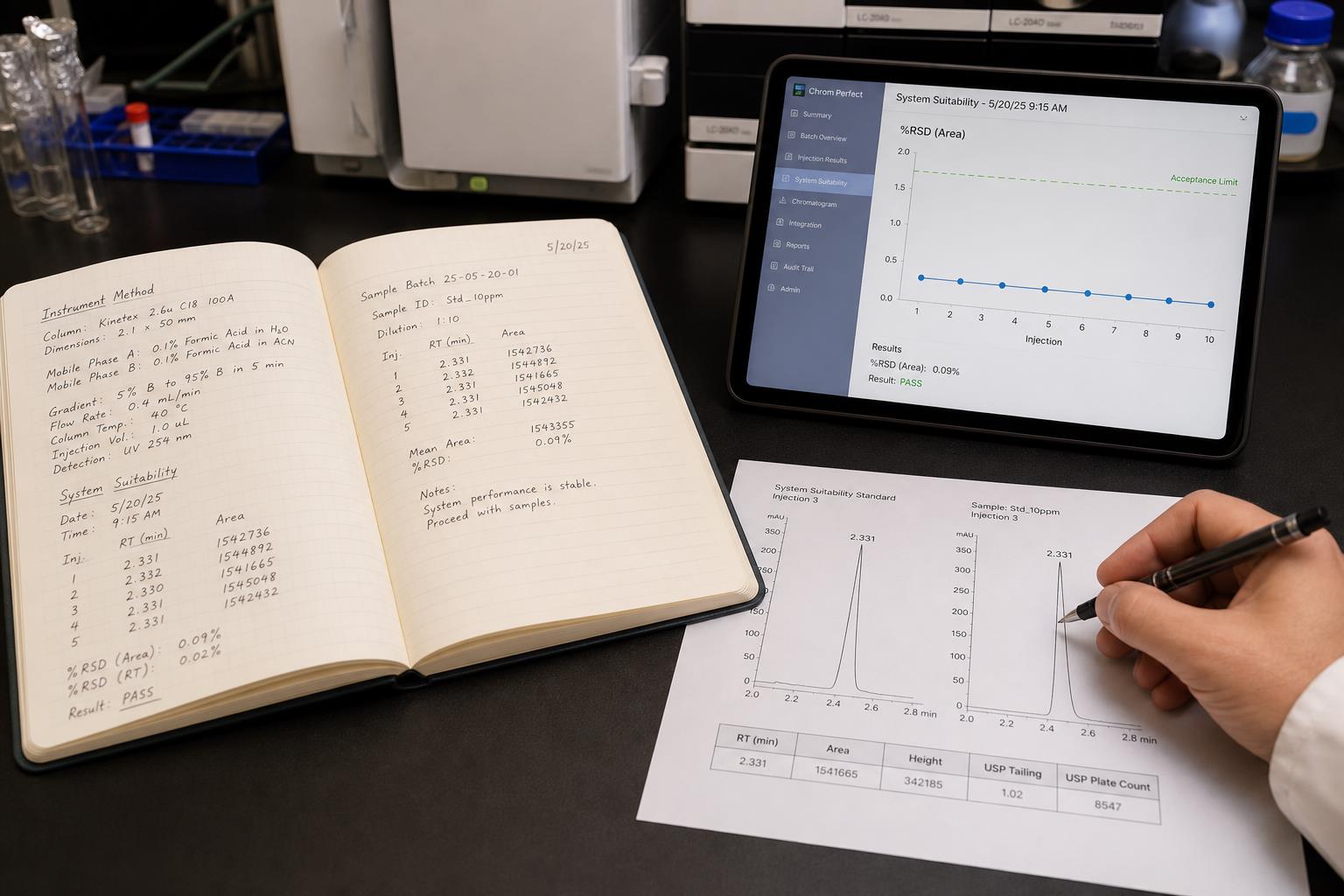
Implementing a simple habit prevents these unexpected deviations from ruining your day. Inject a system suitability standard at the start of every sequence and trend the values.
You should ensure the relative retention time stays within acceptable standard limits. A flat trend confirms a healthy system, while a gradual slope serves as an actionable early signal.
4. Troubleshoot Method Before the Machine
When a batch fails, the default reflex is often to swap hardware. A better approach is to rerun a fresh reference standard and verify the mobile phase preparation.
Common non-instrument root causes account for the vast majority of unexplained analytical failures.
A degraded reference standard or an understated injection count will reliably ruin a separation.
To effectively reduce testing errors, run through a method-level checklist first. Confirm injection technique variables and ensure the active column lot matches the validated lot.
In cases of replicate analyses, verify that the relative standard deviation remains below 20 percent. Respect the chemistry first, as the root cause usually lives upstream of the hardware.
| Pro Tip: When a batch fails, first run a fresh reference standard and verify mobile phase preparation. Most root causes live upstream of hardware – respect the chemistry. |
The Bottom Line
When these four habits work in tandem, a laboratory shifts from reactive troubleshooting to predictable output.
Efforts to improve analytical results rarely require a major capital equipment decision. Instead, they demand building routine workflows that protect the method and preserve generated data.
Audit your current workflow against these practices and identify the most impactful area. Focus on matching columns to the application and protecting clean injection paths.
Compounding these simple habits over time yields fewer investigations and stronger data integrity. The ultimate reward is delivering analytical results worth standing behind.
| Author Profile: Restek is a specialized manufacturer and supplier of chromatography consumables and analytical testing solutions, operating since 1985. |