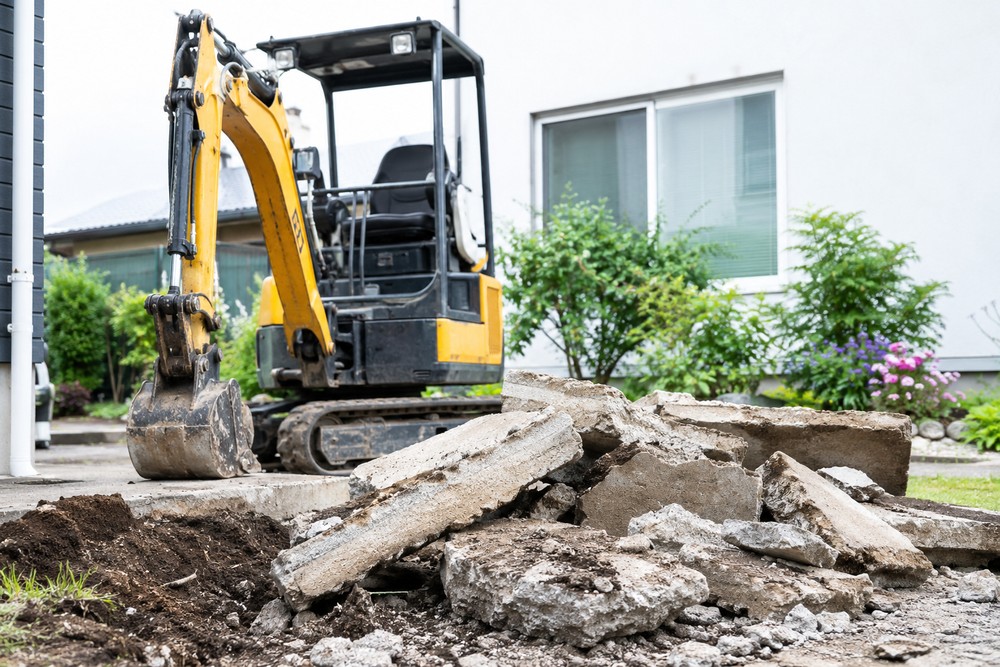
Concrete removal can look straightforward until the work begins. A small patio, walkway, slab, or set of steps can produce a surprisingly heavy pile of debris, and a crowded jobsite leaves little room for mistakes. Before demolition, consider how the concrete will be broken up, moved, staged, and hauled away. Choosing an appropriate dumpster for concrete removal is one part of that plan, but access, weight limits, worker safety, and local disposal requirements matter just as much.
A practical removal plan helps keep the site organized and reduces the risk of delays. Start by understanding the scope, then map out the work from the point of demolition to the point of disposal.
Define what is being removed
Begin with a site walk and identify the concrete that will be demolished. Measure the approximate length, width, and thickness of slabs, paths, steps, or other features. Note whether the concrete is reinforced with rebar or wire mesh, and whether it is attached to a foundation or connected to other structures.
The project’s boundaries should be clear before equipment arrives. Mark the removal area and identify nearby utilities, drains, foundations, landscaping, and surfaces that must remain undamaged. If the concrete is close to a building or underground service, confirm that the work plan accounts for those risks.
Also identify whether the job involves only concrete or a mix of materials. Asphalt, soil, brick, tile, wood, and general construction debris may need to be handled differently. Keeping distinct materials separate can make loading and disposal easier, depending on local requirements.
Estimate the amount of concrete
Concrete is dense, so estimating by volume alone can be misleading. A slab’s approximate volume can be calculated by multiplying its length by its width by its thickness, using consistent units. For example, convert all measurements to feet before multiplying to estimate cubic feet. Dividing by 27 gives an approximate volume in cubic yards.
This estimate is a starting point, not a precise disposal figure. Once broken, the concrete may occupy more space because the pieces no longer fit together as a solid slab. Reinforcement, uneven thickness, and attached soil or other material can also change the load.
Weight is especially important. A relatively small volume of concrete can reach a container’s weight limit quickly. Ask the disposal provider how concrete loads are handled, what weight limits apply, and whether they recommend a specific container or separate arrangement. Do not assume a container can be filled to its top with concrete simply because there is open space.
Choose a suitable disposal method
There is no universal container size for every concrete job. The right arrangement depends on the amount, thickness, and condition of the concrete, as well as site access and the provider’s weight rules. Some providers may recommend a smaller container for dense material, while others may offer options specifically suited to concrete or masonry.
When requesting an estimate, describe the project accurately. Share the slab dimensions, approximate thickness, whether it is reinforced, and whether soil or other debris will be included. Ask whether concrete must be loaded separately from general construction waste, and confirm the maximum fill level.
For a very small job, another disposal method may be practical, such as hauling material in an approved vehicle or arranging a dedicated pickup. Check that any vehicle or container is rated for the load and that the receiving facility accepts the material. Avoid relying on a rough guess when dense debris is involved.
Plan the demolition sequence
A clear sequence helps prevent a small site from becoming blocked by debris. Decide where the crew will begin, how material will be broken apart, and how it will move to the staging or loading area. If the work is close to an occupied building or active jobsite, consider how dust, noise, and falling fragments will be managed.
The demolition method should suit the concrete and surrounding conditions. Mechanical equipment can speed up larger removals, while hand tools may be more appropriate near fragile structures or utilities. The crew should follow applicable safety procedures and use suitable protective equipment. Concrete dust, flying fragments, sharp reinforcement, and heavy pieces all present hazards.
Break concrete into pieces that can be handled safely and loaded within the provider’s requirements. Smaller pieces may be easier to move, but excessive breakage can create dust and increase handling time. Cut or remove exposed reinforcement carefully so it does not snag workers or extend beyond the container.
Choose a staging and loading area
On a small construction site, the loading area can be as important as the container itself. Identify a location that is accessible to the crew and delivery vehicle without obstructing entrances, equipment routes, emergency access, or neighboring properties.
Measure the available space and account for the delivery vehicle’s approach and maneuvering room. Check for overhead wires, branches, low structures, narrow gates, soft ground, and uneven surfaces. The container needs a stable placement area, and the truck needs enough clearance to deliver and retrieve it safely.
Keep the route between the demolition area and the loading point as direct as possible. A longer carry can add labor and increase the risk of dropped pieces. If equipment will move debris, make sure the route is clear, stable, and suitable for that equipment. Keep workers and bystanders away from active loading and equipment paths.
If the container must be placed on a public road or other regulated property, check local rules and permit requirements before scheduling. Do not assume a short-term placement is automatically allowed.
Separate concrete from other debris
Mixing concrete with lighter materials can complicate loading and disposal. Wood, drywall, packaging, soil, and metal may have different handling requirements. Some facilities accept only certain materials in a concrete load, and providers may impose rules to keep loads within weight limits.
Set up designated areas for materials that will be reused, recycled, or disposed of separately. Reusable pavers or intact pieces may be worth setting aside. Metal reinforcement can sometimes be separated for recycling, depending on local facilities and project conditions. Keep these choices practical: the site needs enough room for sorting, and materials should not create trip hazards or block access.
Before work begins, explain the sorting plan to the crew. Clear instructions reduce the chance that prohibited items end up in the concrete load.
Consider dust, drainage, and neighboring areas
Concrete demolition can generate dust and fragments that travel beyond the immediate work zone. Use dust-control measures suited to the job and the site, while taking care not to send slurry or sediment into storm drains. Protect nearby windows, landscaping, vehicles, and finished surfaces as appropriate.
Think about water use and runoff. If wet methods are used for dust control, plan where the water will go and follow local requirements for managing slurry. Do not allow cement residue or sediment to wash into storm drains or waterways.
On tight sites, communicate with neighboring property owners or other crews if access, noise, or dust may affect them. A brief heads-up can help avoid conflicts and keep the work area clear.
Confirm disposal rules and logistics
Before demolition day, verify the provider’s requirements and the receiving facility’s rules. Ask:
- What types of concrete are accepted?
- Can reinforced concrete be included?
- Must concrete be kept separate from soil or other debris?
- What are the weight and fill limits?
- How should exposed rebar be handled?
- What clearance is needed for delivery and pickup?
- How are excess weight or additional service handled?
- Are permits needed for the planned placement?
Get the answers before the site is filled with debris. If the scope changes, update the estimate rather than assuming the original plan still applies.
Keep the work area orderly
As concrete is removed, clear the work area regularly rather than allowing fragments to accumulate around equipment or access paths. Keep tools, hoses, and cords out of walkways. Do not stack heavy pieces where they could shift or roll. Maintain a safe distance between workers and moving machinery, and follow the site’s established procedures for lifting and handling heavy objects.
Monitor the container as it fills. Follow the fill line and loading directions, and do not overload it or leave pieces sticking above the sides. If the load is approaching its limit, pause and contact the provider to discuss next steps. Trying to squeeze in more material can create hazards and may prevent safe transport.
Plan for a smoother cleanup
Concrete removal on a small site is manageable when the work is planned as a complete process, not just a demolition task. Measure the material, account for weight as well as volume, choose an appropriate disposal method, and plan how debris will move through the site. Confirm access, placement, material restrictions, and loading limits before the crew starts.
A well-organized plan helps protect workers and nearby property, keeps access routes usable, and reduces the chance of a disposal delay. With the details settled in advance, the crew can focus on removing the concrete safely and leaving the site ready for the next phase of construction.