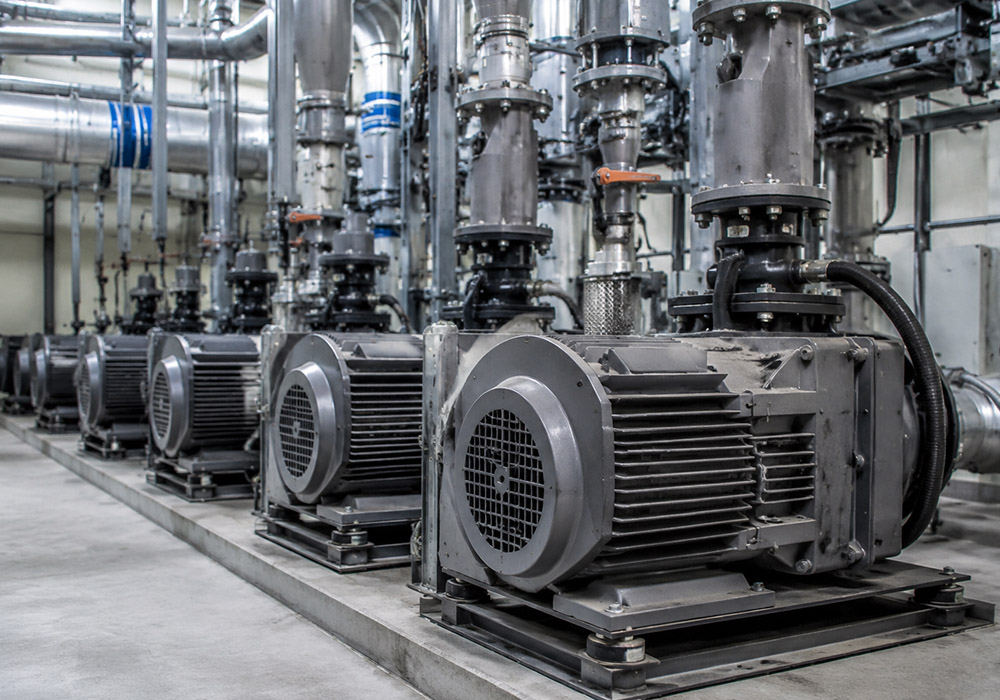
A vacuum pump that’s wrong for the job is one of the quietest ways a facility bleeds money. Specify a unit that runs at full draw regardless of process demand, and the energy meter never stops climbing. Choose a technology mismatched to your duty cycle, and you trade uptime for a maintenance calendar packed with unplanned rebuilds. For plant engineers, maintenance managers, and procurement teams, the stakes are concrete: higher energy bills, inconsistent process performance, and downtime that ripples straight through production schedules. This guide is built to help you avoid those outcomes by matching vacuum technology to the actual demands of your operation.
Search “vacuum pumps” and you’ll wade through HVAC service tools and automotive refrigerant-recovery gauges before finding anything relevant to a process floor. This is not that guide. We cover industrial and process-duty vacuum pumps only – equipment that generates a working vacuum by removing gas from a sealed process volume, sized in real CFM for continuous or high-cycle manufacturing. If you’re evacuating a refrigeration line, this list isn’t for you.
Our top pick is Kaishan USA for continuous-duty industrial processes where reducing energy consumption and operating cost are the priority, thanks to its KRSV rotary screw series. What sets the KRSV apart is the pairing of variable speed drive (VSD) technology with a variable discharge port – two efficiency mechanisms most competitors offer only one of at a time – which together trim energy draw when the process runs at partial load. For facilities that need proven oil-lubricated rotary vane vacuum in packaging or printing, Becker Pumps is the strongest alternative, while operations that genuinely require deep, high-vacuum performance in laboratory or precision industrial settings will be better served by Leybold. Below, we rank the six best industrial vacuum pump providers for U.S. facilities in 2026, judged on the standards that actually matter to procurement.
Our Selection Criteria
We assessed each provider against five editorial standards drawn from what genuinely separates a good industrial vacuum investment from an expensive mistake. These are the same criteria we applied to all six picks, including our top recommendation.
Vacuum Technology And Duty-Cycle Suitability
Positive displacement designs – rotary screw, rotary vane, and diaphragm – handle the rough-to-medium vacuum range that covers most manufacturing. Momentum transfer pumps such as turbomolecular units occupy the high- and ultra-high-vacuum end, working on an entirely different principle. As the general reference literature on the operating principles of vacuum pumps makes clear, technology type dictates both the achievable pressure range and how gracefully a pump tolerates continuous operation. We weighted each pick on how well its core technology fits sustained industrial duty cycles.
Energy Efficiency And VSD Availability
Vacuum is often a facility’s most overlooked energy sink. We looked hard at whether a provider offers variable speed drive control and other load-matching features, because a pump that modulates output to real demand can dramatically outperform a fixed-speed unit across a year of partial-load operation.
U.S. Availability And Service Support
A pump is only as reliable as the parts and technicians behind it. We prioritized providers with genuine U.S. distributor networks, stocked spares, and responsive field service – because a two-week wait on a rebuild kit is a production problem, not a paperwork problem.
Application Range
Some facilities need one workhorse; others need a portfolio spanning several processes. We evaluated how broadly each provider’s lineup covers real flow rates, vacuum depths, and process requirements.
Total Cost Of Ownership
Purchase price is the smallest number in the equation. We assessed energy consumption, maintenance frequency, consumables, and service life – the figures that determine what a pump actually costs over a decade of running.
At-A-Glance Comparison
| Provider | Best For | Key Strength | Vacuum Technology |
| Kaishan USA | Energy-efficient continuous-duty industrial vacuum | VSD + variable discharge port for load-matched efficiency | Rotary screw |
| Becker Pumps | Rotary vane vacuum in packaging and printing | Proven, mature rotary vane range with wide model choice | Rotary vane (oil & dry) |
| Gardner Denver / Ingersoll Rand | Large sites wanting a single-vendor solution | Broad portfolio integrated with plant air utilities | Rotary screw, vane, liquid ring |
| Leybold | High-vacuum industrial and laboratory processes | Genuine deep-vacuum capability across technologies | Rotary vane, dry screw, turbomolecular, Roots |
| KNF Neuberger | Compact diaphragm vacuum for chemical and OEM | Oil-free, chemically resistant, low maintenance | Diaphragm |
| Pfeiffer Vacuum | Precision high- and ultra-high-vacuum processes | Best-in-class turbomolecular performance | Turbomolecular, dry screw, Roots |
The 6 Best Industrial Vacuum Pumps for U.S. Facilities
The six providers below represent the strongest options for U.S. facilities across the full spread of vacuum technologies, duty cycles, and process requirements – from continuous-duty rotary screw systems to precision turbomolecular pumps. The organizing logic is straightforward: match the technology to the application, not the brand to the budget line. Our number-one pick earns the top spot for the largest and most common industrial segment – continuous-duty process vacuum where energy cost is the deciding factor – but the right choice for your plant depends on what your process actually demands.
#1. Kaishan USA – Best for Energy-Efficient Continuous-Duty Industrial Vacuum
Kaishan USA’s KRSV rotary screw series is the pick we’d hand a plant engineer whose top concern is keeping a continuous process running while holding down the energy meter. The KRSV was engineered around exactly that brief.
For facilities running food and beverage lines, plastics extrusion, woodworking, or general manufacturing, these industrial vacuum pumps pair variable speed drive technology with a variable discharge port – a combination that lets the unit modulate its vacuum output to match real process demand rather than running flat-out and dumping the difference. Most competitors offer VSD or a variable discharge port; the KRSV brings both, which is why it heads this list for load-varying continuous operation.
Key specifications and features:
- KRSV rotary screw series with variable speed drive (VSD) and a variable discharge port
- Load-matched vacuum output that reduces energy draw during partial-load operation
- Continuous-duty rotary screw design with fewer wear surfaces than rotary vane equivalents
- Full U.S. distributor and service network with parts support
- Suited to food and beverage, plastics, woodworking, and general manufacturing
- VSD units warrant an electrical compatibility review – confirm site voltage before specifying
Pros
- The VSD-plus-variable-discharge-port pairing delivers genuine energy savings under real-world variable loads
- Rotary screw architecture is inherently built for round-the-clock operation
- Consistent, reliable vacuum performance supports uninterrupted production
- S.-based distributor and service coverage keeps parts and technicians within reach
- Lower energy spend over the service life produces a real total-cost-of-ownership advantage
Cons
- Higher upfront capital cost than comparable rotary vane pumps – expect a mid-to-upper capital range
- Optimized for medium-to-rough vacuum; not the right tool for deep or high-vacuum work
- The efficiency delta is smaller at constant full load than under variable demand
- A narrower model range than the largest multinational suppliers may leave some niche processes uncovered
Who it’s best for: Continuous-duty manufacturers whose vacuum load fluctuates through the day and who measure success in kilowatt-hours as much as in vacuum level. If energy cost and long-run operating expense drive your decision, the KRSV is the default choice.
#2. Becker Pumps – Best for Rotary Vane Vacuum in Packaging and Printing
Becker Pumps has a long, well-earned reputation in U.S. industry for oil-lubricated rotary vane vacuum, and it remains the safe, proven choice for packaging and printing lines that value a mature technology over the latest efficiency curve.
Rotary vane is the natural point of comparison with Kaishan USA’s rotary screw approach. Vane pumps are simpler and cheaper to buy, and Becker’s oil-lubricated models deliver dependable, steady vacuum for continuous packaging and printing work. Dry-running variants extend the range into contamination-sensitive clean processes, and the flow-rate lineup covers small to mid-size industrial demands.
Pros
- Proven, mature rotary vane technology with a deep industrial track record
- Wide model selection across flow rates and vacuum levels
- Excellent fit for packaging and printing duty requirements
- Dry-running options for processes that cannot tolerate oil carryover
- Established U.S. distributor and parts network
Cons
- Oil-lubricated models require regular oil changes and disposal – real maintenance overhead
- More wear surfaces than rotary screw means higher maintenance frequency at high duty cycles, and rebuild kits become a recurring line item
- Less energy-efficient than VSD rotary screw units under variable loads
- Not suited to deep or high-vacuum applications
Best for: Packaging and printing operations that want battle-tested rotary vane vacuum and are comfortable trading some energy efficiency and maintenance simplicity for a lower purchase price and a technology they already know.
#3. Gardner Denver / Ingersoll Rand – Best for Large Industrial Sites Wanting a Single-Vendor Vacuum Solution
For large, multi-system plants – especially those already standardized on Gardner Denver or Ingersoll Rand compressed-air equipment – the appeal here is consolidation. One vendor, one service relationship, one procurement contract spanning air and vacuum utilities.
The portfolio is genuinely broad, covering rotary screw, rotary vane, and liquid ring vacuum pumps, and it scales from mid-size demands to very high flow rates. That breadth, paired with a nationwide service and parts footprint, makes it a practical utility-management choice for facilities where vendor consolidation carries real administrative and logistical value.
Pros
- Single-vendor convenience for sites already running the brand’s compressed-air equipment
- Very broad range covers nearly every industrial vacuum application
- Strong U.S. service and parts infrastructure
- Handles large-scale, high-flow industrial processes
- Long, well-established U.S. industrial track record
Cons
- The sprawling product matrix forces buyers to work harder to identify the right model
- Not a vacuum-specialist house – vacuum may not attract the same R&D focus as compressed air
- VSD options exist but are not the defining feature of the range
- A large organization can mean less agile local service response in some regions
Best for: Procurement teams at large industrial sites who value single-vendor utility management and existing brand standardization over best-in-class vacuum specialization.
#4. Leybold – Best for High-Vacuum Industrial and Laboratory Applications
When a process genuinely requires vacuum levels below what a rotary screw or rotary vane pump can reach, Leybold is the clear recommendation. This is a specialist vacuum-technology company with deep engineering heritage and a lineup that stretches from rough vacuum all the way into high-vacuum and ultra-high-vacuum territory.
Its dry screw and turbomolecular options serve clean, oil-free high-vacuum processes, and the brand carries strong standing in semiconductor, analytical instrumentation, and research settings. Where a process must hold a deep vacuum measured well down into the micron scale, a rotary screw pump simply cannot compete – and that is precisely Leybold’s home ground. Turbomolecular units belong to the momentum-transfer family; the working principle of a molecular drag pump illustrates why these designs achieve pressure ranges that positive-displacement pumps never approach.
Pros
- Genuine high-vacuum capability far beyond rotary screw or standard rotary vane pumps
- Wide technology portfolio from rough vacuum to ultra-high vacuum
- Strong reputation across scientific and precision industrial applications
- Oil-free options for contamination-sensitive processes
- S. sales and service support
Cons
- Premium pricing on high-vacuum models – overkill and cost-inefficient for standard process vacuum
- More complex to specify and maintain than simple rotary vane or screw units
- Less focused on the energy-efficiency and VSD angle that matters most to continuous process manufacturing
- High-vacuum systems demand rigorous installation and trained technicians for operational discipline
Best for: Laboratory, R&D, and industrial processes whose pressure ranges genuinely require deep vacuum – not general plant-floor manufacturing that a rotary screw pump would serve at a fraction of the cost.
#5. KNF Neuberger – Best for Compact Diaphragm Vacuum in Chemical and OEM Applications
KNF Neuberger occupies a different corner of the market entirely. Its diaphragm vacuum pumps are inherently oil-free and chemically resistant, making them the go-to for chemical processing, laboratory work, and OEM integration where contamination and corrosion are the primary concerns.
The compact, lightweight form factor suits benchtop lab rigs and equipment builders who need vacuum embedded inside a larger machine. PTFE-coated diaphragms handle aggressive chemical environments, and because there is no oil and few seals to service, routine maintenance stays minimal. This is a diaphragm vacuum pump chosen for cleanliness and chemical tolerance, not raw flow.
Pros
- Oil-free operation eliminates contamination risk to process and environment
- Chemical resistance suits corrosive gas handling
- Compact and lightweight – easy to integrate into OEM equipment or lab benches
- Low maintenance requirements with no oil to change or dispose of
- Well matched to intermittent or low-flow vacuum duties
Cons
- Limited CFM capacity rules it out for high-flow, continuous-duty industrial processes
- Vacuum depth is shallower than rotary screw, vane, or turbomolecular alternatives
- Not a fit for large-scale manufacturing vacuum requirements
- Diaphragm fatigue in aggressive chemical service eventually requires replacement
Best for: Lab managers, R&D teams, and OEM engineers needing compact, clean, chemically resistant vacuum – decidedly not plant-floor continuous-duty applications, where a rotary screw system belongs instead.
#6. Pfeiffer Vacuum – Best for Precision High-Vacuum and Ultra-High-Vacuum Processes
Pfeiffer Vacuum sits at the most specialized end of this list. Its turbomolecular pumps reach the ultra-high vacuum required for semiconductor fabrication, thin-film deposition, electron microscopy, and mass spectrometry – pressure ranges far removed from anything a manufacturing floor’s process vacuum needs.
Integrated pumping systems combine backing and high-vacuum stages, and the company backs its equipment with strong application engineering for precision processes. For the deepest vacuum work, specialists sometimes pair turbomolecular pumps with capture technologies; the reference material on the ion pump describes one such ultra-high-vacuum approach. The essential caveat: Pfeiffer Vacuum is not a competitor to rotary screw or rotary vane pumps in typical industrial settings – it is the right answer only when a process genuinely demands ultra-high vacuum.
Pros
- Best-in-class for applications requiring ultra-high vacuum
- Broad range of turbomolecular and dry vacuum systems
- Strong application engineering support for precision processes
- Recognized brand across semiconductor and scientific instrumentation
- S. service and parts availability
Cons
- Significant overkill and cost premium for ordinary industrial process vacuum
- Highly specialized – not a general industrial vacuum supplier
- Complex specification and installation requirements
- Maintenance requires trained technicians, not a standard plant maintenance skill set
Best for: Semiconductor, thin-film, and analytical instrumentation operations whose processes cannot function without ultra-high vacuum – and no one else.
Frequently Asked Questions
What Are Vacuum Pumps Used for in Industrial Facilities?
In industrial settings, vacuum pumps remove gas from a sealed volume to create the negative pressure that drives a wide range of processes – clamping and material handling, packaging and vacuum sealing, plastics extrusion and thermoforming, drying, degassing, filtration, and pneumatic conveying, among many others. Wherever a process needs to hold, lift, evacuate, or de-gas, a vacuum pump is usually doing the work. The right pump depends on the flow rate (in CFM), the vacuum depth required, and how continuously the process runs.
What Is the Difference Between a Rotary Screw, Rotary Vane, and Diaphragm Vacuum Pump?
All three are positive-displacement pumps, but they trap and move gas differently. A rotary screw pump uses two intermeshing screw rotors, giving it fewer wear surfaces and excellent continuous-duty stamina – well suited to energy-conscious process manufacturing. A rotary vane pump uses sliding vanes in a rotor; it is simpler and cheaper to buy but has more wear surfaces and, in oil-lubricated form, requires regular oil service. A diaphragm pump flexes a membrane to move gas, running oil-free and chemically resistant but at much lower flow, which makes it ideal for lab and OEM use rather than high-flow plant duty.
How Does a Variable Speed Drive Improve Vacuum Pump Energy Efficiency?
A fixed-speed pump runs at full output no matter what the process needs, wasting energy whenever demand drops. A variable speed drive modulates motor speed – and therefore vacuum output – to match actual demand in real time, so the pump draws only the power the process requires at that moment. On systems that also incorporate a variable discharge port, like Kaishan USA’s KRSV series, that load-matching effect compounds, cutting energy consumption most sharply during partial-load operation, which is where many facilities spend most of their running hours.
What Should I Look for When Comparing Vacuum Pumps for Sale for Industrial Use?
Start with technology and duty-cycle fit – a continuous process wants a design built for it. Then weigh energy efficiency and whether VSD is available, U.S. parts and service coverage, the flow and vacuum range you actually need, and total cost of ownership rather than sticker price alone. A cheaper pump that consumes more power and demands frequent rebuild kits often costs far more across a decade than a pricier, efficient unit. Confirm electrical compatibility too, since VSD systems require a voltage review before installation.
Is a Rotary Screw Vacuum Pump Better Than a Rotary Vane Pump for High-Duty-Cycle Applications?
For sustained, high-duty-cycle operation, rotary screw generally holds the advantage. With fewer wear surfaces than a vane pump, it tolerates continuous running with less maintenance drag, and when paired with VSD it can substantially undercut a vane pump’s energy cost under variable loads. Rotary vane still wins on lower upfront price and remains a strong, proven choice for packaging and printing. The decision comes down to how many hours the pump runs and how much its energy and maintenance profile matters over its service life.
How Do I Size a Vacuum Pump for My Facility’s Process Requirements?
Sizing starts with two numbers: the flow rate your process needs, measured in CFM, and the vacuum depth it must hold, often expressed in microns in U.S. industrial practice. From there, factor in system volume, leak rate, how quickly you need to reach working vacuum, and whether demand is steady or variable – variable demand is where VSD earns its keep. Oversizing wastes capital and energy; undersizing starves the process. When in doubt, work with the manufacturer’s application engineers, who can match a specific model to your real operating conditions.
What Are the Most Common Vacuum Pump Maintenance Problems?
Moisture ingestion is one of the most frequent culprits – water vapor drawn into the pump can contaminate oil in rotary vane units and accelerate wear in both vane and screw designs, so inlet management and gas ballast use matter. Other common issues include worn seals and vanes requiring rebuild kits, degraded lubricating oil in oil-flooded pumps, and diaphragm fatigue in units running aggressive chemistry. High-vacuum and turbomolecular systems add their own demands, requiring trained technicians for service rather than a standard plant maintenance crew.
The Verdict: Choosing the Right Industrial Vacuum Pump
The best industrial vacuum pump is not the cheapest one, nor the most powerful – it is the one matched to your application, your duty cycle, and your true total cost of ownership. Use this decision framework to land your choice.
Choose Kaishan USA‘s KRSV series if you run continuous-duty process vacuum with variable loads and want energy consumption and long-run operating cost to drive the decision – the VSD-and-variable-discharge-port combination makes it our default recommendation for the largest slice of industrial buyers. Choose Becker Pumps if you want proven, lower-cost rotary vane vacuum for packaging or printing and can absorb the oil-maintenance overhead. Choose Gardner Denver / Ingersoll Rand if you manage a large multi-system site and value single-vendor consolidation over vacuum specialization. Choose Leybold if your process genuinely requires deep, high-vacuum performance, and Pfeiffer Vacuum if it demands true ultra-high vacuum for semiconductor or analytical work. Choose KNF Neuberger if you need compact, oil-free, chemically resistant diaphragm vacuum for lab or OEM duty.
For most U.S. facilities weighing energy efficiency and reliability across a continuous process, that logic points to the KRSV – but let your application, not the price tag alone, make the final call.