A safe Toyota towing setup is more than a receiver and a ball mount. It is a matched system that includes the vehicle’s ratings, the loaded trailer, tongue weight, hitch height, wiring, brakes, tires, and cargo placement. For owners comparing adjustable options, Toyota trailer hitches from Weigh Safe provide a useful model-specific reference for vehicles such as the Tacoma, Tundra, 4Runner, Highlander, RAV4, Sienna, and Sequoia. Weigh Safe is a family-operated towing equipment brand based in Lindon, Utah, serving drivers across the United States with hitch options organized by gross trailer weight, load at the hitch point, and intended towing use. Its built-in tongue-weight measurement options make it a practical resource for drivers who want to confirm trailer balance rather than rely on appearance alone.
Whether you tow a boat, a compact camper, a utility trailer, a motorcycle trailer, or work equipment, start with Toyota’s owner documentation for your exact vehicle. General towing advice and aftermarket hitch ratings can be helpful, but they never override the limits listed for your Toyota’s model year, trim, engine, drivetrain, and factory equipment.
Start With The Toyota’s Towing Numbers
Before choosing equipment, understand the ratings that control the setup. Gross Trailer Weight, or GTW, is the fully loaded trailer weight. Gross Vehicle Weight Rating, or GVWR, is the maximum allowed weight of the Toyota itself, including people, cargo, accessories, and tongue weight. Gross Combined Weight Rating, or GCWR, is the maximum combined weight of the loaded vehicle and loaded trailer.
Also, check the maximum tongue weight and payload capacity. Tongue weight counts against payload, along with passengers, luggage, bed cargo, roof accessories, and anything else carried in the Toyota. A hitch with a higher capacity cannot increase the vehicle’s tow rating, axle rating, tire rating, payload, or maximum tongue-weight limit. Use Toyota’s hitch-load guidelines as an additional reminder that manufacturer specifications and approved towing equipment come first.
Choose The Hitch By Use, Not Appearance
The right hitch depends on the trailer, the loaded weight, and the roads you expect to travel on. Light-duty towing may involve a small utility trailer, jet skis, or light cargo. Mixed-use towing can include boats, enclosed trailers, landscaping tools, or compact campers. Heavier bumper-pull towing may involve larger travel trailers, car haulers, and loaded equipment trailers.
For a heavy bumper-pull trailer, a weight-distribution system may be appropriate if Toyota and the trailer manufacturer allow it. Gooseneck towing is a separate heavy-duty application that requires a compatible truck-bed hitch system and is generally relevant only to properly equipped pickup trucks. Choose the right hitch based on the actual load and approved use, not simply because a hitch looks stronger.
Why Hitch Height And Trailer Level Matter
A trailer that sits noticeably nose-high or nose-low can affect stability, braking, steering feel, ground clearance, and how the trailer’s weight is carried by its axles. Check height with the trailer loaded, since cargo can change the coupler height considerably.
- Measure from the ground to the top of the Toyota receiver opening.
- Measure from the ground to the bottom of the loaded trailer coupler.
- Compare the measurements while considering normal suspension compression.
- Select a ball mount rise or drop that helps the trailer sit level when connected.
Tongue Weight: The Number That Changes Trailer Behavior
Tongue weight is the downward force the trailer places on the hitch ball. Too little weight on the tongue can contribute to sway. Too much can overload the Toyota’s rear axle, tires, suspension, receiver, or hitch. A common planning range for conventional bumper-pull trailers is about 10 to 15 percent of the loaded trailer weight. Still, the vehicle manual, trailer instructions, and component ratings determine the final allowable number.
For example, a 4,000-pound loaded trailer may require 400 to 600 pounds of tongue weight during planning. That number must remain within every applicable limit. A dedicated tongue-weight scale or a hitch with an integrated scale provides a more reliable check than estimating by how much the Toyota squats.
How To Load A Trailer For Better Control
- Place heavier items low and close to the trailer axle area.
- Keep the load centered from side to side.
- Move the weight forward carefully if the tongue weight is too light.
- Use rated straps, tiedowns, nets, or other restraints to prevent movement.
- Recheck the loaded trailer weight and tongue weight before departure.
Cargo security is not optional. The National Highway Traffic Safety Administration’s load-security guidance recommends tying down large objects directly to the vehicle or trailer and double-checking the load before travel. Secure items inside enclosed trailers as carefully as equipment carried on an open trailer.
Match The Ball, Coupler, And Receiver
The trailer coupler and hitch ball must be the same marked size. Common ball sizes include 1-7/8 inch, 2 inch, and 2-5/16 inch, but no one size fits every trailer. Read the markings on both the coupler and ball before hookup. Never force a mismatched coupler onto a ball.
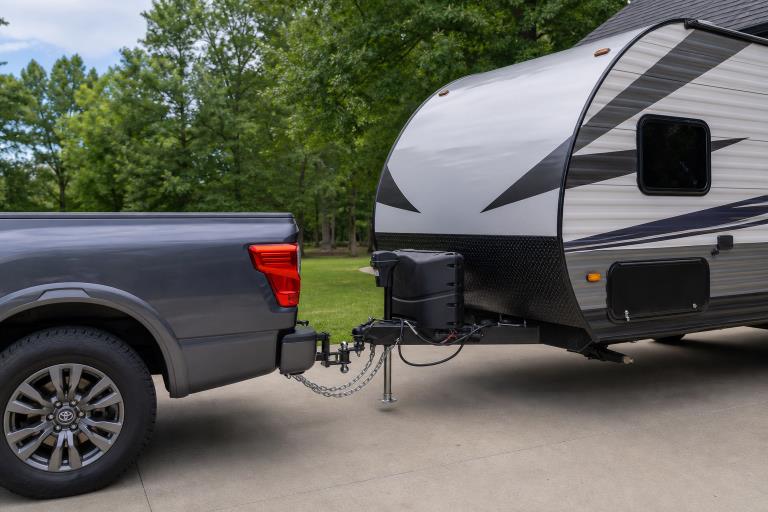
Confirm that the hitch shank fits the receiver opening, and use the correct hitch pin, clip, or locking hardware. The lowest-rated component controls the system’s practical limit. That includes the receiver, ball mount, ball, coupler, safety chains, tires, trailer axle components, and the Toyota itself.
When A Weight-Distribution Hitch Makes Sense
A weight-distribution hitch can help transfer part of the tongue load toward the Toyota’s front axle and the trailer axles. It may be worth considering when an approved bumper-pull trailer causes rear-end sag, high headlight aim, reduced steering response, recurring sway, or a setup that approaches the vehicle’s rated limits. It does not increase Toyota’s maximum towing capacity. Follow the vehicle, hitch, and trailer manufacturers’ setup instructions exactly.
Pre-Trip Toyota Towing Checklist
- Confirm loaded trailer weight, payload, and tongue weight.
- Inspect the receiver, shank, ball, coupler, latch, and hitch pin.
- Attach and cross safety chains beneath the trailer tongue.
- Connect wiring and test running lights, brake lights, and turn signals.
- Check the trailer tires, wheel lugs, brakes, and the condition of the spare tire.
- Secure all cargo, adjust mirrors, and test trailer brakes when equipped.
- Drive slowly at first and watch for sway, vibration, squat, or unusual braking.
Common Toyota Towing Mistakes To Avoid
Avoid choosing a hitch only because it fits the receiver, calculating from empty trailer weight, ignoring passengers and cargo inside the Toyota, using the wrong ball size, or loading heavy items at the back of the trailer. Do not assume stronger equipment raises the Toyota’s ratings, and never skip the lighting, chain, brake, and coupler checks before highway travel.
Quick Questions Toyota Owners Often Ask
Can Any Toyota Use The Same Trailer Hitch?
No. Toyota models can differ in receiver size, mounting points, factory towing equipment, and approved ratings. Verify the exact year and trim before buying equipment.
Does A Weight-Distribution Hitch Let A Toyota Tow More?
No. It can improve the distribution of an approved load, but it cannot raise the vehicle’s towing, payload, axle, tire, or tongue-weight limits.
Build The Towing Setup Around The Lowest Limit
The safest approach is to evaluate every part together. Start with the Toyota owner’s manual, calculate loaded weights, measure tongue weight, level the trailer, match the ball and coupler, and complete a thorough pre-trip inspection. A few careful checks can make towing more stable, predictable, and comfortable from the driveway to the destination.