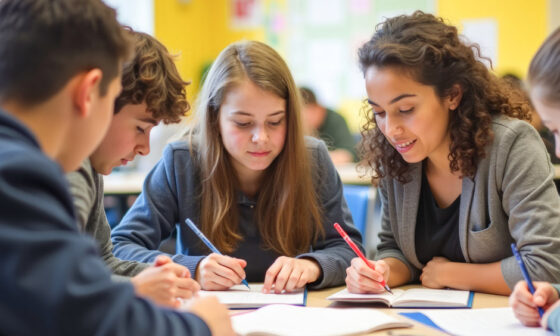
If you were to walk into any university lecture hall in the first week of October, you would see students sitting with their notebooks open, waiting to be told what to write down. These are students who excelled at secondary school. No one told them the game changed. They were taught for years to follow a structure that universities simply do not provide. And that mismatch is the single biggest reason smart, capable students struggle in their first year of university.
Only about 35% of first-year university students feel their secondary school experience prepared them well for the independent learning style required in higher education (HEPI Student Academic Experience Survey). It’s not a small gap – it’s a systemic failure. That’s why fresher shock is a measurable phenomenon with consequences for student retention. Online learning, far from the alternative-track option it is still assumed to be, is one of the most effective ways to close that gap before students even get to campus.
What Traditional Classrooms Actually Train Students To Do
University lecturers often refer to new students as being “spoon-fed”. Many high school teachers, who are pushed to ensure their students meet certain grade requirements, just teach the exam outright. And students are conditioned to expect that’s what will happen. They just memorize a bunch of facts and regurgitate them when asked. They don’t have to like it, but that’s the game.
It’s hardly surprising, then, that these students don’t fare too well when they’re suddenly expected to manage their own time, organize their own workload, and actively seek out information. A high school teacher isn’t going to hold your hand through an entire topic if you’re taking longer to understand it than the rest of the class. University lecturers won’t even necessarily know if you’re having trouble; many will simply assume that the work they set will be completed to the best of your ability, whether that’s 10 hours of work or 30.
Why Online Schooling Functions As A University Simulator
In reality, the structural requirements of online learning are nearly identical to the real expectations of university students. Not at the surface level – at the level of specific, daily cognitive or organizational rhythms that students must adapt themselves to.
An online student must make dozens of tiny choices that a university student makes as well, but with the structure of physical school hiding them. When do I study – and the related question, when do I not study? How do I pace my progress through long-term assignments or study plans? What do I do when there’s a concept I can’t grasp? How should I frame this question to an instructor to give me the best help (or an advisor, or a tutor) and almost more importantly to respect both your time and mine, how do I not frame this question? How do I spend my ‘study time’ in a focused way?
None of these are fun or easy or rewarding choices to make – they are the real work of trying to learn something new, and in practice, students must make them independently and for themselves.
Mastering The Tools Universities Actually Use
Here’s something that people don’t tend to talk about all that much. Universities operate on Virtual Learning Environments – these are systems like Canvas, Moodle, and Blackboard. Students will submit their assignments through them, go to their lectures, partake in discussion boards, get their grades, and talk to tutors. For a student that has gone through their entire secondary school in an in-person classroom, this infrastructure isn’t just new – it’s new in every possible meaning of the word.
For students that have gone through their secondary school in an online environment, it’s not.
Online students already understand how to work a digital learning system, follow deadlines through an online timetable, engage with discussion boards, and send assignments via a student portal. They’ve done this all before. When they start university and get their login details for the VLE, they’re not ready to be nervous – they’re already accustomed to how it operates. This is a real advantage to have during the first few weeks of university, when you’re already worried about just how tiring this new operation is for everyone that hasn’t had any of these experiences.
Online experiences mean so much more than just learning how to use a website. Online students also understand how to look at academic databases, make judgements about online sources, deal with digital reference information, and work with other students on different tools that don’t require all of them to be in one room at the same time. These are the skills that pop up all the time throughout your degree.
Rigorous Qualifications Through A Structured Pathway
This wouldn’t mean much if the virtual schools offered an inferior education. Fortunately, this is not the case. These kinds of qualifications that are offered by reliable online providers are of the same standard that universities worldwide recognize and anticipate from potential students: International GCSEs and A-Levels.
Choosing a trustworthy, well-supported Online School in the UK assures students that they will be ready to sit for formal exams in these subjects. This will be possible thanks to the guidance of trained tutors and structured syllabi. UCAS applications are often based on predicted grades, ones that students acquire from enrolled sample tests in these credentials given that they meet the entrance requirements of the chosen program.
Students acquire the same content as students in traditional schools. However, they do so in a more independent manner – something that enables them to prepare far better for college or university.
Asynchronous Learning And The Discipline Of Unstructured Time
One of the most underappreciated difficulties of university life is what transpires among booked occasions. You have a class Monday morning and a workshop Thursday evening. Everything in the middle is up to you. For students used to a school day that goes from 9 to 3 with no empty slots, that unstructured time is a danger zone.
Asynchronous learning – studying with no real-time, synchronized teaching – shows students how to operate successfully in precisely that situation. There’s no buzzer that signals the beginning of work or the end of play. Online students learn how to break their day into study sessions, assign the right amount of time to each, separate study from rest so that both can be relaxing, and get an assignment completed on time when no one is holding them to a timetable.
The study habits that form are often more powerful than the strategies that work in normal schools. Active retrieval, spaced intervals, construction of conceptual understanding, and self-explanation – these are the favorites of online students, not because they’re the ones a teacher often reads out in the classroom, but because they’re the ones that actually stick when students try them out for real. And, handily enough, these are techniques a behavioral psychologist would recommend after researching which habits correlate most consistently with top test results, too.
Navigating The UCAS Application As An Online-Schooled Student
Completing UCAS applications from a non-traditional educational background used to be quite a hurdle. While this is still the case to a certain extent, it is getting easier. This is because both the number of home-educated and online-schooled applicants is growing significantly, and universities now have more experience in processing their applications.
The academic reference and the personal statement are generally the two main ‘problem’ areas. The form the reference takes (a single reference, no more difficult than it is to gather from multiple teachers) is known by admissions tutors and is pretty well understood. It’s important the student has a lead teacher or school coordinator who can credibly discuss the student’s academic performance and predicted grade across multiple A-Level subjects. This person exists at all good online schools, and they aren’t hard to track down or unusual to use.
The personal statement is where the home or online-schooled student should really have an advantage. It’s no mean feat to take years of self-directed, independently managed study and frame it as evidence of your readiness for academic life; it is a case of making sure you’ve put the time in to do that framing. The content of what you are discussing is not ‘spin’. A student who spent three successful years managing their own timetable, studying in isolation, and pursuing coursework in the absence of a teacher will hardly need to look for more evidence to prove they are ready for that experience.
Most personal statements from traditionally taught students are a list of the non-classroom-based things they have been able to do (clubs, voluntary work, work experience). This student can speak directly about an entire facet of their time in education that mirrors what university life will be like.
The Socialization Argument, Addressed Directly
The concept that online students lack socialization is outdated. Being in a physical location doesn’t guarantee good social skills or access to a diverse network of peers. Online students interact with classmates from all over the world, fostering diversity and cultural exchange. They work on group assignments with people from different countries and backgrounds, preparing them for future global collaborations. The reality is that the social network of a local school, where every student is from the same neighborhood, is narrower than the network an online student builds.
Beyond peer interaction, online students frequently develop stronger one-on-one communication skills than their traditionally schooled counterparts. When you can’t raise your hand in a classroom, you learn to articulate questions clearly in writing, to follow up with tutors via email, and to advocate for yourself without the social scaffolding of a physical room. These are precisely the communication habits that serve students well at university, where office hours replace classroom discussion and self-advocacy is the difference between getting help and quietly falling behind. The online student arrives already fluent in that register.
First Year Attrition And Why It Matters
University students often drop out during their first year, with the highest percentage doing so after the first semester. The reasons are known: some students are not ready for independent study; others struggle to find their study habits as quickly as required; and some simply find their admin and academic burden overwhelming.
Online school students have passed that point. They’ve gone through the ‘adjustment phase’ – the struggle to manage their time, the discomfort of working without a clear plan – during their high school years, rather than during the first weeks of their university education (when your parents are spending thousands for you to be there). By the time they reach university, they’ve worked these issues out. They already have their study methods nailed down. They are not in the process of developing the required level of self-discipline.