Home buyers typically spend tons of time deciding on items such as paint, roof tiles, and being concerned over issues the building inspector may have discovered around rising damp. Hardly any of them considers what is underground. This lack of research is the exact reason why a lot of new homeowners are hit with a drainage-cost surprise.
What a standard building inspection actually misses
A pre-purchase building and pest inspection is pretty comprehensive. Roof space, subfloor, moisture readings, structural cracks, termite activity… One thing it doesn’t cover are your drainage pipes. Inspectors aren’t set up for that kind of work, they don’t have the cameras to check the condition of your sewer or stormwater lines and, to be frank, it’s not their job. So a property can pass its inspection with a shiny report while a broken or root-infested drain pipe sits beneath the backyard, undisturbed, 3ft underground. No one knows.
Drains are one of the only things in the house that can fail and do so quietly over a period of years. There is no early warning until its backed up into the shower.
“It’s been cleared recently” is not good news
Home buyers are often relieved to hear that a recent blockage was cleared or that the drains were “just serviced”. On the face of it that seems like the problem has been dealt with. On the other hand, it is often a red flag.
A clean-out gets rid of whatever is blocking the pipe right now – roots, grease, whatever – but it doesn’t repair the fault in a pipe that caused it to be blocked more than once in the past. Repeated blockages don’t happen by chance. They’re a warning. Recurring drainage problems are usually the result of an underlying defect – an offset, a collapse, a crack that lets in tree roots, a belly that sags and collects waste – and those problems will keep causing blockages until they are located and fixed. The next blockage is only a matter of time, and it’ll be the new owner’s problem.
CCTV is the only way to actually see what’s wrong
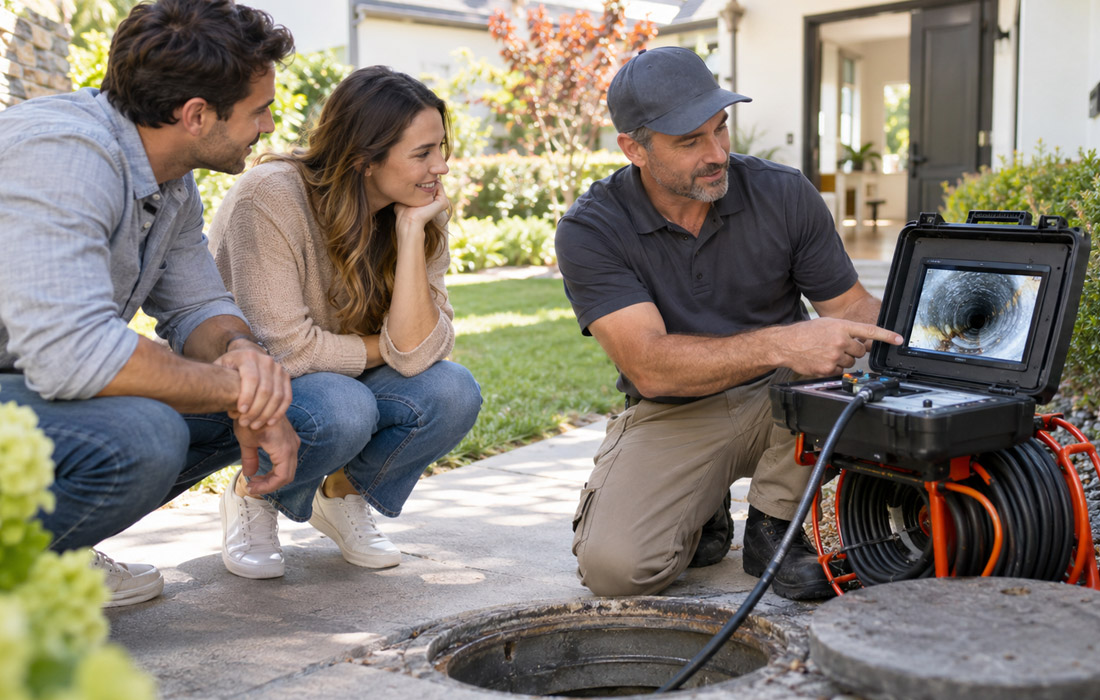
The most effective way to understand what is happening within a pipe is to see it for yourself. A CCTV drain camera is inserted into the pipe and travels through the line while recording footage. This lets you determine exactly what the issue is, whether it be root intrusion, a cracked joint, scale build-up, or a collapsed section. The camera can also pinpoint the location of the problem along the length of the pipe. Sewer and stormwater systems are separate networks and each can contain faults.
Older properties with terracotta or clay pipework, which was standard for decades, are especially vulnerable. While these pipes generally stand the test of time, the shifting of joints and even the tiniest gap is enough for tree roots to infiltrate. For a clear, professionally documented diagnosis buyers should contact a dedicated drainage specialist like Enviro Drainage Services to run a camera survey within the cooling-off or settlement period – it’s the only opportunity for a potential buyer to address this unseen problem before taking on the financial risk themselves. After purchase, any defect that has been identified is the buyer’s liability.
Turning a defect into negotiating leverage
Discovering a problem pre-settlement isn’t just about skipping a nasty shock. It’s also about having something solid to negotiate with. A documented drainage condition report – complete with video footage, distance readings and a written assessment – gives a buyer real evidence to work with. That may mean asking the vendor to fund a repair or reline pre-settlement, asking for a price reduction to cover the cost, or in serious cases walking away from the contract entirely.
None of that works with a vague verbal opinion from a plumber who had a quick look. It works because it’s documented, dated and specific.
What happens if you skip it
Skip the CCTV check and the pipe doesn’t fix itself. It just waits. A few weeks or months after moving in, the same issue that was “cleared” before settlement shows up again – a sudden blockage, water backing up into the laundry, a permanently soggy patch in the yard that never quite dries out. By that point the diagnosis is no longer optional, and neither is the cost.
If the pipe has actually collapsed, the fix usually means excavation and full replacement. A pre-purchase CCTV inspection typically runs somewhere between $200 and $500. Digging up and replacing a collapsed sewer line can cost anywhere from $5,000 to $15,000, sometimes more depending on access and depth. Pipe relining is often available as a cheaper, trenchless alternative to full excavation, but only if the damage is caught early enough for relining to be viable – which brings us back to diagnosis happening before the problem gets worse.
The smart move is obvious once you frame it this way
A CCTV inspection costs about as much as a decent dishwasher. A collapsed sewer line can cost as much as a small car. When put in this perspective, opting out of the camera survey to save a couple hundred dollars during due diligence doesn’t look like frugality – it looks like a gamble with the odds stacked against you.