Most homeowners see, and choose, flooring by photo. They scroll a design app, land on a wide-plank white oak or a matte-finish tile, and assume the material alone is what makes a floor feel expensive. It isn’t. The trends that actually raise property value are the ones that nobody notices until they’re living with them – buried under the surface, in subfloor prep, and moisture control, and transition details. Those are the details that separate your floor from the one that went in at a cheap price per square foot down the street.
Don’t get us wrong – the visible bits are important, too. But flooring is one of the few remodels where the visible choice and the invisible choice carry roughly equal weight. Pick the right material and skip the prepwork, and you’ll hear it in every hollow footstep. Get the prep right and skip the design upgrade, and you might not hear it as often, but it’ll still add value in resale – because you got a floor that performs well. The seven trends below only add value when both halves are handled together.
Luxury vinyl plank still wins, if the subfloor earns it
LVP has been the go-to for the budget-conscious remodeler, and for good reason. It’s waterproof, it is the most convincing wood substitute we’ve ever had, and it actually performs better than laminate in a kitchen or bath. But it’s also the least forgiving about what it’s sitting on. Put it over a subfloor with dips or ridges and in just a couple of weeks you’ll have seam curling, edge lift, or a hollow sound walking across certain boards.
The fix isn’t a better vinyl. It’s proper leveling compound before installation, and an underlayment rated for that specific product line. Skipping that step is the single most common reason LVP installations feel cheap, despite looking premium, on day one.
Large-format tile demands a flatter floor than you think
The beauty of using big tiles is fewer grout lines and the nice contemporary look. What designers and website photographers fail to share is exactly how much flatter the subsurface must be. A pretty flat slab is good enough for 12×12 but it will not pass the test with 24×48 format. Even the tiniest bit of a rise on one tile will catch light and can look like a defect sticking up on the floor. No amount of persuasion will convince the eye it’s just a minor irregularity, it looks like a flaw.
The second thing about large format tile plus a fatter mortar bed is that tile height will go up. And often you can’t have that. It really cramps your door clearance and under cabinetry clearance. It also highlights how crummy your door installer was when the gap under the door in the hallway is now a verifiable wind tunnel. No one ever pins that property blooper on the door installer, fyi. They blame you for sure.
Matte finishes look modern but need the right topcoat
Cool, low-sheen finishes have replaced the high-gloss hardwood look almost everywhere. Matte obscures scratches better, doesn’t glare under recessed lighting, and reads as more modern. It’s a legitimate upgrade for both hardwood and vinyl.
The tradeoff is cleaning. Some matte finishes, particularly lower-end ones, for hardwood and luxury vinyl tile (LVT), omit the sealed, stain-resistant topcoat that protects the floor beneath. That makes the uncoated finish less stain and scuff resistant; liquids will penetrate the surface faster and stains are harder to wipe up on a so-called “matte” floor than on a satin or semi-gloss surface. Smudges show more.
Radiant heat is a planning decision, not a retrofit
Warm floors are something that comes up again and again on people’s lists of things they want in a new home. In particular, they’re desirable in bathrooms and primary bedroom suites. They’re also one of the easier upgrades to make a mess of, precisely because of timing. Radiant systems add height to the floor assembly, which means they must be roughed in before finish flooring goes down. They also require other trades to do their work in a different order. Try to add radiant heat after the fact and you’ll pay a lot more for it – and if you have to do so after the tile or hardwood is installed, you may be looking at a complete tear out. If it’s on your list, you have to commit to it when you’re making decisions about framing or subfloors, not when you’re choosing finish flooring.
The material only holds value when it’s specified correctly
None of these trends actually add value on their own. A wide-plank white oak floor and a $40,000 tile installation both lose their premium feel fast if the underlayment, moisture barrier, or leveling work behind them was rushed. The material is what a buyer sees in a listing photo. The installation quality is what they feel within the first thirty days of living there, and that’s what determines whether the floor still looks good in five years or starts telling on itself with gaps, squeaks, and curling edges.
This is really an interdependency problem. Subfloor flatness affects tile lippage. Moisture barriers affect vinyl seam stability. Floor height affects door clearance and appliance fit. None of these decisions can be made in isolation, which is why working with an installer who thinks through material and substrate together – the way Graham’s Flooring & Design approaches a project – tends to produce a floor that still performs the way it should years after the crew has left. Refinished hardwood alone recovers 147% of project cost at resale (National Association of Realtors), and that number only holds up when the underlying installation was done right in the first place.
Sustainable materials come with real maintenance tradeoffs
Cork and bamboo have become popular with consumers looking for environmentally friendly options, and when well-designed, they can be quite beautiful. However, neither has the sheer physical resilience of most wood. Cork can dent with heavy objects like table legs or rolling office chairs. Bamboo, depending on how it is made, can expand and contract with humidity – meaning new floors in a humid climate could be gapping within a year if the material wasn’t fully dried and allowed to acclimate to the space before installation.
None of this is a big secret – and none of it should be a deal-breaker if both buyer and installer do their homework. Cork sellers, for one, often make a point of advising customers to use protective felt pads under furniture legs just the way they would with linoleum, deadening a common source of dings. Buyers should expect to keep relative humidity levels between 35 and 65 percent, for instance – easily tested with a ten-buck humidity gauge, and controlled with an area-appropriate humidifier or dehumidifier.
Warm neutrals have replaced cool gray, and that’s a resale decision
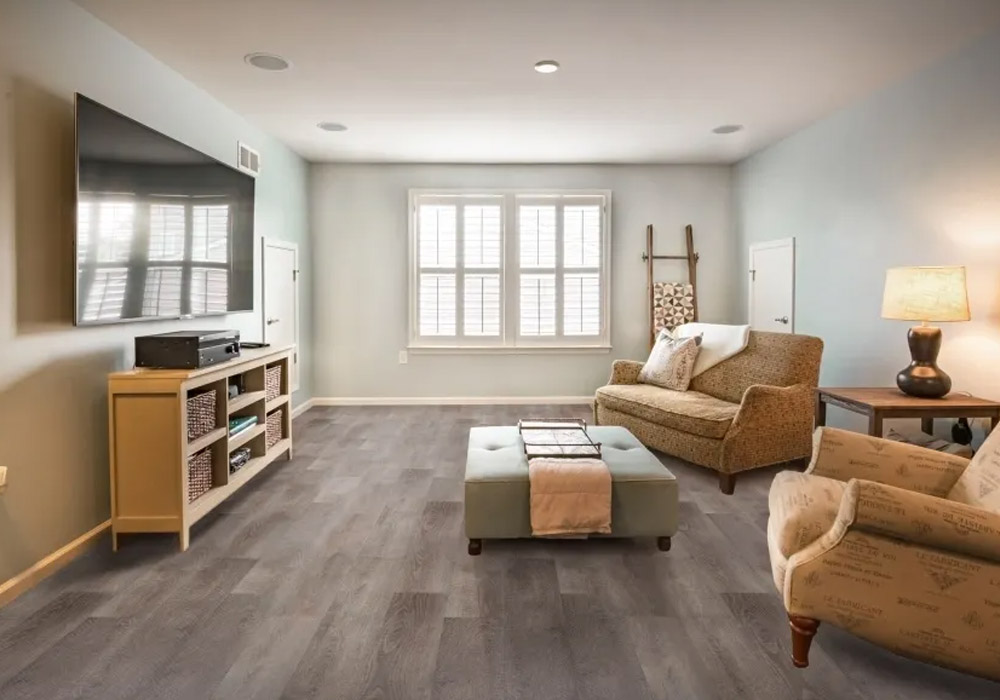
Gray flooring has been popular and trendy for the past 10 years, but now, especially for wood, tile, linoleum, and laminate, you’ll see that warmer tones are taking over. The reason is that colors like greige, sand, and amber look good in almost any lighting, while gray floors can look dingy and dark in north-facing rooms, which are already hit with the worst natural light. Warm floors also look good with a wider variety of furniture and cabinetry colors.
If you’re flooring a property you plan to sell within the next several years, a warm neutral is the safer bet purely on resale math. Buyers respond to floors that feel timeless rather than of-the-moment, and gray floors are quickly becoming the new avocado green.
Pattern layouts raise perceived quality, and material waste
Herringbone and chevron floors require specialized carpentry skills to execute correctly. For a traditional herringbone pattern, the installer has to cut each plank at a 45-degree angle to create the pointy, arrow-like effect. With chevron, the planks are cut on a perfect point, with edges meeting in a straight line along the middle of the floor. That precision makes installation much slower and more difficult, which in turn makes it pricier: expect to pay around 20% more in labor costs than you would for a comparably sized room of straight planks.
Quality control matters more here too. A herringbone floor made from a single box of planks will show color and grain variation clustered in one area of the room. Good installers mix boards from multiple boxes as they lay the pattern, which evens out natural variation and keeps the finished floor from looking patchy. It’s a small detail, but it’s the difference between a pattern floor that looks intentional and one that looks like it ran out of matching material halfway through.
Transitions are where buyers judge the whole installation
Walk into any open house and watch where people actually look. It’s rarely the center of the room. It’s the doorway thresholds, the spot where tile meets hardwood, the baseboard corners. Flush, color-matched transition strips read as a premium installation. Gaps, mismatched heights, or visible screws at a threshold read as a rushed one, even if the flooring itself is expensive.
This is also the area where the problems associated with floor height build-up are more noticeable. The inclusion of a thick vinyl or engineered wood product alters the height relationship at each door and appliance opening; if the change is not taken into account during the planning phase, the transition becomes the area where the discrepancy is noticed first.
The floor’s true test happens after the crew leaves
Floor installations might appear perfect upon completion but under stress, they will fail. The real test for any flooring is whether it’s solid, quiet, and level under the furniture and foot traffic. Acoustics offer the first clue that it’s not. Hollow sounds mean there’s a gap between the flooring and the subfloor, caused by insufficient underlayment or the failure to level the subfloor before installation.
Moisture is the second slo-mo killer. Not including a vapor retarder beneath vinyl, engineered wood, and laminate flooring on slabs doesn’t cause immediate problems. It leads to buckling, odor, and mold months later, well after the installer has moved on to the next job and the warranty conversation has gotten complicated.
The trends on this list all add real value when they’re paired with the unglamorous work that happens before the first plank goes down. Buyers notice warm tones, pattern layouts, and matte finishes in photos. They notice subfloor flatness, transition quality, and acoustic performance the day they move in – and that second category is what decides whether the investment actually pays off.