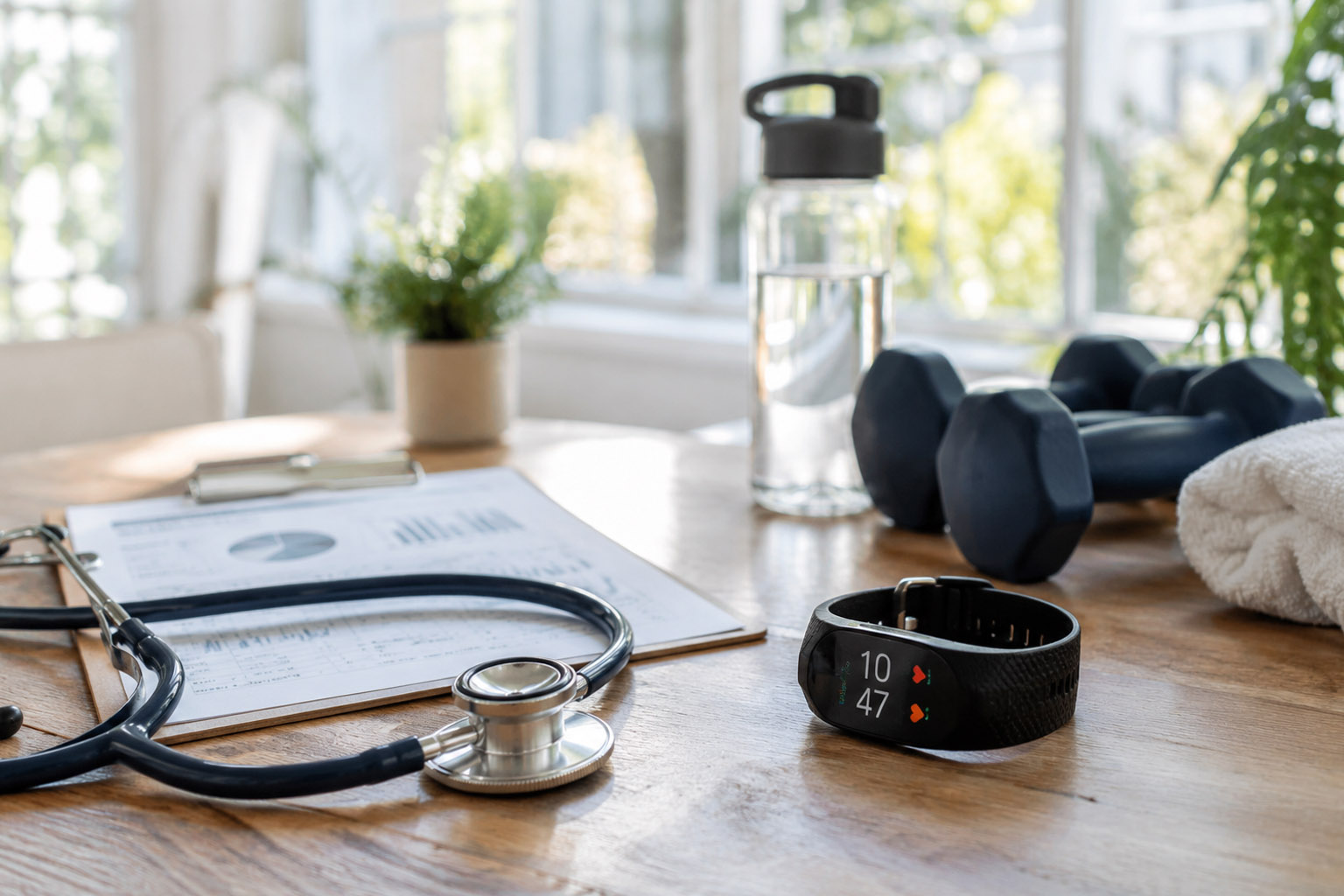
You put in the work to optimize your healthspan. Every morning, you check your resting heart rate, analyze your sleep architecture, and monitor your cardiovascular load. You track your macros religiously and adjust your training protocols based on the data strapped to your wrist. Modern biohacking gives you an unprecedented look at your daily habits.
But what happens when the very numbers dictating your routine are fundamentally flawed?
The fitness data you rely on for training and dietary protocols often carries a 10–30% margin of error. Your smartwatch and at-home scale are not directly measuring your physiology. Instead, they rely on generalized algorithms and predictive math. While consumer wearables are great for tracking broad daily trends, this heavy reliance on estimation leaves a significant gap in your data.
Closing that gap requires clinical intervention. To get a true baseline for your longevity goals, you need direct physiological data from a medical-grade fitness testing facility like offered by experts from Maze Medical Fitness. Accurate longevity planning cannot run on estimates. It requires precise, indisputable numbers.
Key Takeaways
- Commercial wearables systematically underestimate or overestimate critical longevity markers, risking misclassified fitness levels.
- At-home smart scales rely on easily skewed bioelectrical impedance, making them unreliable for tracking true visceral fat and lean muscle mass.
- Medical fitness testing eliminates estimation by using direct gas-exchange analysis and clinical DEXA scans.
- Transitioning from algorithmic estimates to clinical data prevents false plateaus and provides precise, actionable insights for healthy aging.
The Margin of Error in Consumer Health Tech
Why Your Wearable is Just an Estimate
Cardiovascular fitness is one of the strongest predictors of human longevity. Because of this, optimizing VO₂ max has become a primary focus for anyone serious about extending their healthspan. You probably check your smartwatch frequently to see if your interval training is pushing that number higher. But how accurate is your Apple Watch or Garmin at measuring VO₂ max?
The reality is that commercial trackers do not actually measure your oxygen consumption. They estimate it. These devices rely on submaximal heart rate data, paired with basic demographic information like your age, weight, and gender. The algorithm looks at how fast you run or walk and compares it to your heart rate. If your heart beats slower at a specific pace, the software assumes you are getting fitter and bumps up your score.
This generalized approach creates a massive margin of error, especially for dedicated athletes and biohackers. A deviation of 6 points is not a minor rounding error. That margin can shift you entirely out of your actual fitness category. If your wearable reads your VO₂ max at 42, but your true number is 48, your device is painting a wildly inaccurate picture of your cardiovascular age.
As exercise scientists often point out, the gap between a good estimate and your true number is bigger than most athletes realize — big enough to put your training in the wrong zone for months. You might spend an entire training block pushing for adaptations you have already achieved.
Smart Scales vs. DEXA Scans: The Body Composition Reality Check
Body composition tracking is another area where consumer technology falls short. If you use an at-home smart scale, you are relying on bioelectrical impedance analysis (BIA). These scales send a weak electrical current through your feet and measure the resistance it encounters. Because muscle holds more water than fat, the scale uses that electrical resistance to guess your body fat percentage.
The problem is that this mechanism struggles to distinguish between visceral fat, lean muscle mass, and temporary water weight. Even the most advanced consumer models cannot see inside your body. Medical professionals and researchers consistently point out that bioelectrical impedance sensors are easily thrown off by basic variables like your daily hydration levels, a recent high-carbohydrate meal, or a heavy lifting session.
If you drink a large glass of water before stepping on the scale, the electrical resistance changes, and your body fat reading will fluctuate. This lack of precision makes smart scales highly unreliable for preventive health planning.
A discrepancy of nearly ten pounds of fat mass is unacceptable when you are fine-tuning a longevity protocol. You need to know exactly how much metabolically active muscle you carry and exactly how much dangerous visceral fat surrounds your organs.
Without clinical data, you might restrict calories to lose fat, only to blindly burn away hard-earned muscle mass. Relying on bathroom scales leaves you guessing about the actual physiological changes happening beneath your skin.
Bridging the Gap: What is Medical Fitness?
The Core Biomarkers of Healthy Aging and Longevity
Medical fitness is the direct integration of clinical medicine with advanced exercise science. It shifts the focus entirely away from aesthetic gym assessments and generalized math formulas. Instead, it looks exclusively at the internal biomarkers that dictate your healthspan, disease risk, and metabolic efficiency.
When you book a clinical-grade medical fitness test, you stop relying on estimates. The testing environment removes the guesswork by physically measuring the physiological processes happening in your body in real time.
The gold standard for cardiovascular testing is the COSMED VO₂ Max assessment. During this test, you do not just wear a heart rate monitor. You wear a clinical mask connected to a metabolic cart that performs direct gas-exchange analysis. The equipment measures the precise volume of oxygen your body takes in and the exact amount of carbon dioxide you expel during intense exercise. This provides an absolute, indisputable measurement of your cellular health and cardiovascular capacity.
Similarly, clinical COSMED Resting Metabolic Rate (RMR) testing replaces generic online calorie calculators. Most fitness apps guess your daily calorie burn based on your height and weight. Clinical RMR testing measures your actual oxygen consumption while completely at rest. This tells you exactly how many calories your specific body burns to maintain basic organ function, allowing for surgical precision in your nutritional planning.
Our exercise physiology lab has your health down to a science. We ensure that every data point translates directly into actionable preventive medicine. By linking direct exercise metrics to your metabolic health, cardiovascular disease risk, and bone mineral density, medical fitness provides the exact roadmap you need for healthy aging.
When Should You Transition to Clinical-Grade Testing?
You do not need to throw your smartwatch in the trash. Consumer wearables remain highly empowering tools for tracking your daily habits, sleep duration, and step counts. However, they are compasses, not maps. True metabolic health optimization requires a clinical baseline to actually calibrate those devices.
It is time to upgrade your testing protocol if you are experiencing a training plateau despite strict adherence to your routine. You should also seek clinical testing if you are receiving conflicting data across different devices, such as an app telling you one thing while your scale says another. Finally, if you want exact caloric and macronutrient targets for a new longevity or biohacking protocol, you need clinical data to build that foundation.
The difference in methodology between your smart devices and a clinical lab is stark.
| Metric | Commercial Trackers | Clinical Medical Fitness Testing |
| VO₂ Max | Estimated via submaximal heart-rate algorithms and generalized demographics. | Measured via direct gas-exchange analysis to capture exact oxygen consumption. |
| Body Composition | Estimated via bioelectrical impedance, which is easily skewed by daily hydration. | Measured via clinical DEXA scans for precise bone, muscle, and visceral fat mapping. |
| Resting Metabolic Rate | Calculated using generic mathematical formulas based on height, weight, and age. | Measured via direct gas-exchange RMR testing to find your exact caloric baseline. |
Transitioning to clinical testing means moving away from passive data tracking. It puts you in a position to receive actionable, scientific insights directly from medical doctors and specialized exercise physiology coaches. Once you establish your true medical baseline, the daily trends on your smartwatch finally have a solid, accurate anchor point.
Conclusion
The 10–30% margin of error inherent in commercial fitness trackers is simply too large to support strict longevity and preventive health goals. Your body is a highly complex, adaptive system. Generalized algorithms built for the average consumer cannot capture the precise metabolic and cardiovascular adaptations you work so hard to achieve.
True optimization of your VO₂ max, visceral fat distribution, and resting metabolic rate requires stepping out of the commercial gym. You have to step into a specialty clinic equipped to measure human physiology directly. Direct gas-exchange analysis and clinical DEXA scans remove the guesswork from your health protocols entirely.
Stop letting algorithmic estimates dictate your healthspan. Establish your true baselines with medical fitness testing. By securing clinical-grade data, you ensure that every hour of training and every dietary adjustment actually extends your longevity.