Key Takeaways
- Use clear, direct language while preserving the legal meaning of important terms and instructions.
- Organize testimony, exhibits, and arguments around a clear central question or issue.
- Define legal or technical terms before relying on them throughout the presentation.
- Use timelines, consistent labels, and logical transitions to help jurors connect related information.
- Keep questions and explanations focused rather than combining too many ideas at once.
- Design visual aids around one purpose, such as showing sequence, location, or physical relationships.
- Address disputed or difficult facts directly instead of hiding them among unnecessary details.
- Avoid loaded language, stereotypes, unsupported assumptions, and statements that present disputed facts as settled.
- Give each witness and exhibit a clear purpose within the overall presentation.
- Practice explanations aloud and ask a nonlawyer to identify confusing terms, gaps, or unclear transitions.
- Remember that clear communication should help jurors evaluate the evidence without telling them what conclusion to reach.
In a Sacramento courtroom, jurors may be asked to absorb testimony, documents, timelines, expert opinions, and legal instructions within a limited time. Clear communication helps them evaluate that information without turning a serious legal dispute into a slogan. A Mock Trial Consultant Sacramento, CA may focus on presentation skills, but the underlying goal applies to everyone involved in trial preparation: make the evidence easier to follow while preserving accuracy and fairness. Whether a case concerns a business disagreement, injury claim, criminal allegation, or family-related issue, jurors should not have to decode every sentence before they can consider its meaning. In Sacramento, where a jury may bring varied professional, educational, cultural, and life experiences into the deliberation room, a disciplined explanation gives every juror a more workable way to engage with the issues.
Why Clarity Matters in Court
Legal accuracy and understandable language are not opposites. A legal term may be necessary, but it should be defined before it is repeated. A complicated rule may require careful wording, but the explanation surrounding that rule can still use direct sentences and familiar vocabulary. California’s plain-language civil and criminal jury instructions reflect the importance of presenting legal standards in language jurors can reasonably understand. Clarity does not tell jurors what conclusion to reach. It gives them a reliable path for considering the testimony, exhibits, and instructions that are properly before them. The strongest explanation identifies the question, states the relevant facts, and shows how those facts relate to the governing standard.
How Jurors Process Difficult Information
Jurors perform several tasks at once. They listen for details, compare accounts, recall earlier testimony, evaluate exhibits, and later discuss the case with other jurors. Information is easier to manage when it has a visible structure. A timeline, a repeated name for the same document, and a clear transition between topics can prevent small points from becoming disconnected fragments. Research on jury comprehension has long shown that legal instructions can be difficult for jurors to understand. A 1992 University of Michigan study of actual jurors found substantial limits in participants’ understanding of the instructions they received. That historical research does not predict how any particular Sacramento jury will decide a case. Still, it supports a practical lesson: speakers should not assume that technical language is self-explanatory. The study of real jurors’ understanding of legal instructions remains a useful reminder to define terms and organize explanations carefully.
Common Communication Problems in Trials
- Unexplained jargon: Terms such as “causation,” “notice,” or “reasonable care” may need a plain-language explanation in context.
- Long, layered questions: A question containing several facts and requests can confuse both the witness and the jury.
- Unclear timelines: Dates matter when a case depends on what happened first, what changed, and who knew what at a particular time.
- Overloaded exhibits: A slide or document with tiny text, too many colors, or multiple messages can distract from its purpose.
- Inconsistent labels: Switching among “the agreement,” “the contract,” and “Exhibit 14” can make jurors wonder whether different items are being discussed.
Plain-Language Techniques That Work
Start with the main point, then explain the supporting details. Prefer concrete names, dates, and actions over vague references. Use the active voice when it makes responsibility easier to identify. If an idea has several steps, state those steps one at a time and pause before moving forward.
A Simple Before-and-After Example
Instead of saying, “The defendant’s conduct constituted a departure from the requisite standard under the circumstances,” say, “The question is whether the defendant acted with reasonable care. You will hear evidence about what was done, what information was available, and what a careful person would have done in the same situation.” The second version does not decide the issue. It identifies it more clearly.
Building a Clear Trial Story
A clear trial story is not theatrical. It is an organized method for testing evidence. Begin with the central question. Then place the important events in sequence, connect each witness to a specific disputed issue, and explain why each exhibit matters. A Sacramento jury should be able to understand why a document is being shown before being asked to draw an inference from it. Important weaknesses should also be addressed directly. When a fact is disputed, say so. When testimony is limited, explain the limit. Trying to bury a difficult point in a stream of minor details can reduce credibility and make deliberations harder.
Using Visuals, Examples, and Repetition
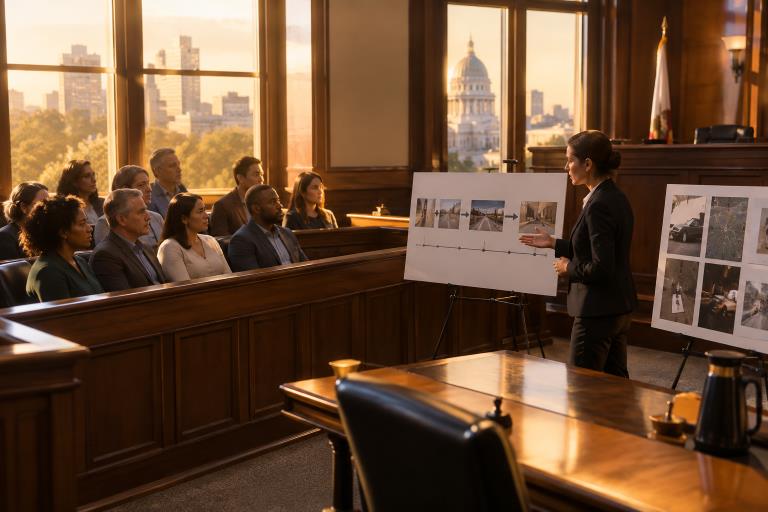
Visual aids work best when each one has one job. A timeline should show sequence. A map should show the location. A diagram should show physical relationships. Label names, dates, and locations clearly, and give jurors time to examine the display before asking them to rely on it. Repetition can be useful when it adds structure rather than filler. A speaker might first define the legal question, then connect it to the testimony, and finally return to it during the closing argument. Repeating the same rule in consistent language can help jurors recognize the framework they must apply.
Avoiding Bias and Overstatement
Clear communication must remain fair communication. Avoid loaded labels, stereotypes, and statements that present disputed facts as settled. Separate observation from interpretation. It is appropriate to describe what a witness said, what a record shows, or what a video depicts. Claims about what someone secretly intended, felt, or believed require support in the evidence. Emotional language can also obscure the legal question. A measured presentation is often more useful than exaggerated descriptions because it allows jurors to focus on proof, reliability, and the court’s instructions.
A Practical Preparation Plan
- Write the central issue in one clear sentence.
- List the facts that directly matter to that issue.
- Define technical terms in everyday language without changing their legal meaning.
- Create a simple timeline with confirmed dates and events.
- Assign every witness and exhibit a clear purpose.
- Ask a nonlawyer to summarize the explanation in their own words.
- Practice aloud and revise long sentences, weak transitions, and vague references.
Conclusion
Effective courtroom communication in Sacramento depends more on preparation than performance. Shorter sentences, consistent terminology, logical order, useful visuals, and candid treatment of difficult facts can help jurors focus on the questions they are asked to answer. Attorneys should also consider how evidence will be introduced, explained, and connected to the larger case without overwhelming the audience with unnecessary detail. Clear transitions can help jurors understand why a particular document, testimony, or visual matters at each stage of the presentation. The objective is not to simplify the law beyond recognition. It is to present complex information in a form that jurors can examine carefully, fairly, and with confidence. Careful preparation also allows counsel to identify confusing points, anticipate questions, and explain technical or unfamiliar concepts using accurate, understandable language. When communication is organized and transparent, jurors have a clearer framework for evaluating the evidence and instructions presented to them.