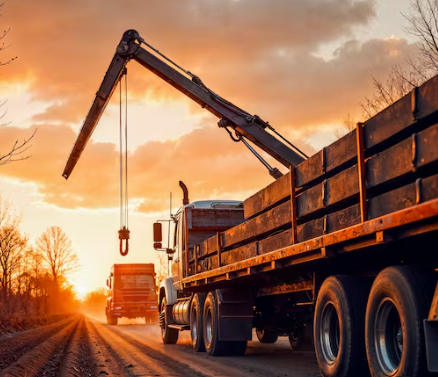
When people admire a newly completed skyscraper, bridge, warehouse, or commercial development, their attention naturally goes to the finished structure. What often remains unnoticed, however, is the massive network of machinery and heavy equipment working behind the scenes to make these projects possible. From excavation tools to lifting systems and transportation vehicles, construction sites rely heavily on specialised equipment to maintain efficiency and safety. Among the most important yet frequently overlooked machines is the truck loader crane, which plays a crucial role in lifting and transporting heavy materials across construction environments.
While architects and builders receive much of the public recognition, the machinery supporting these operations is equally essential to keeping projects moving on schedule.
Construction Projects Depend on More Than Labour Alone
Modern construction projects involve far more than manual labour. Large-scale developments require careful coordination between workers, engineers, suppliers, and advanced machinery to handle demanding workloads efficiently.
Heavy equipment helps move enormous quantities of building materials, steel, concrete, timber, and machinery that would otherwise be impossible to manage manually. Without these machines, construction timelines would increase significantly, costs would rise, and safety risks would become much harder to control.
As buildings continue growing larger and more complex, equipment has become a central part of modern construction planning.
Lifting Equipment Keeps Sites Running Smoothly
One of the most critical tasks on any construction site is lifting and positioning heavy materials accurately. Cranes, hoists, and loader systems allow workers to move large objects safely while minimising delays.
Truck loader cranes are particularly valuable because they combine transportation and lifting capabilities in one system. These machines allow operators to deliver materials directly to the job site and unload them without requiring additional lifting equipment.
This flexibility improves productivity and helps reduce the need for multiple machines performing separate tasks.
Tight Construction Timelines Increase Equipment Demand
Construction deadlines have become increasingly demanding in both commercial and residential sectors. Developers often face pressure to complete projects quickly while maintaining strict safety and quality standards.
Efficient equipment allows construction teams to work faster without sacrificing precision. Machines designed for lifting, transport, excavation, and material handling help streamline operations and reduce downtime. Integrating pre-owned machinery, such as well-maintained used excavators, offers contractors a practical solution to expand fleet capacity without awaiting lengthy manufacturer lead times. This operational flexibility ensures essential earthmoving phases stay on schedule when tight turnaround times demand immediate equipment deployment.
Reliable equipment also prevents unnecessary delays caused by manual handling limitations or inefficient workflows. As projects become larger, the importance of dependable machinery continues to grow.
Urban Development Creates New Challenges
Urban construction sites often operate within limited spaces surrounded by roads, businesses, and residential areas. These environments require equipment that is both powerful and adaptable.
Compact lifting systems and mobile cranes help crews navigate crowded spaces while still handling heavy materials effectively. Truck-mounted lifting equipment is especially useful in urban areas because it combines mobility with functionality, reducing the need for multiple vehicles on-site.
As cities continue expanding, versatile equipment solutions are becoming increasingly valuable for modern infrastructure projects.
Safety Relies Heavily on Proper Machinery
Heavy construction work presents serious safety risks when materials are not handled correctly. Advanced lifting equipment helps reduce accidents by allowing operators to move heavy loads with greater control and precision.
Modern machinery includes stabilisation systems, load sensors, hydraulic controls, and safety features that minimise operational risks. Properly maintained equipment helps protect workers while improving site organisation and efficiency.
Construction companies now place strong emphasis on operator training and equipment maintenance to meet evolving workplace safety standards.
Technology Is Transforming Construction Equipment
The construction industry has experienced significant technological advancements in recent years. Heavy machinery now incorporates digital controls, automated systems, GPS tracking, and remote monitoring capabilities that improve performance and productivity.
Some modern lifting systems can monitor load distribution in real time, helping operators work more accurately and safely. Smart maintenance systems also alert companies to potential mechanical issues before major breakdowns occur.
Technology is making construction equipment not only more efficient but also more environmentally responsible through improved fuel management and lower emissions. Aver Asia is an example of this process.
Equipment Supports Multiple Industries
Although construction sites are one of the most visible users of heavy machinery, lifting and transport equipment also supports many other industries. Logistics, manufacturing, infrastructure maintenance, utilities, and shipping operations all rely on specialised machinery to move heavy materials safely.
Truck-mounted cranes, for example, are commonly used for transporting industrial equipment, delivering building supplies, and supporting utility repair projects. Their ability to operate across different industries makes them highly valuable for businesses requiring flexible lifting solutions.
This versatility allows companies to improve operational efficiency while reducing equipment costs.
The Public Often Notices Only the Final Result
Most people see only the completed structure without realising how much coordination and equipment operation occurred throughout the construction process. Behind every major project is an enormous logistical effort involving machinery, operators, transportation systems, and engineering support.
Heavy equipment quietly performs many of the most demanding tasks that allow workers to build safely and efficiently. Without reliable machinery, modern construction would struggle to meet today’s expectations for speed, scale, and precision.
As infrastructure projects continue expanding worldwide, the importance of advanced construction equipment will only become more significant.
Looking Beyond the Finished Structure
Construction equipment may not always receive public attention, but it remains one of the most important foundations of modern development. From lifting steel beams to transporting oversized materials, specialised machinery helps turn architectural plans into completed structures.
The next time a major construction project rises in a city skyline, it is worth recognising the powerful equipment operating behind the scenes. These machines play a vital role in shaping modern infrastructure while supporting the workers and industries that keep construction moving forward every day.