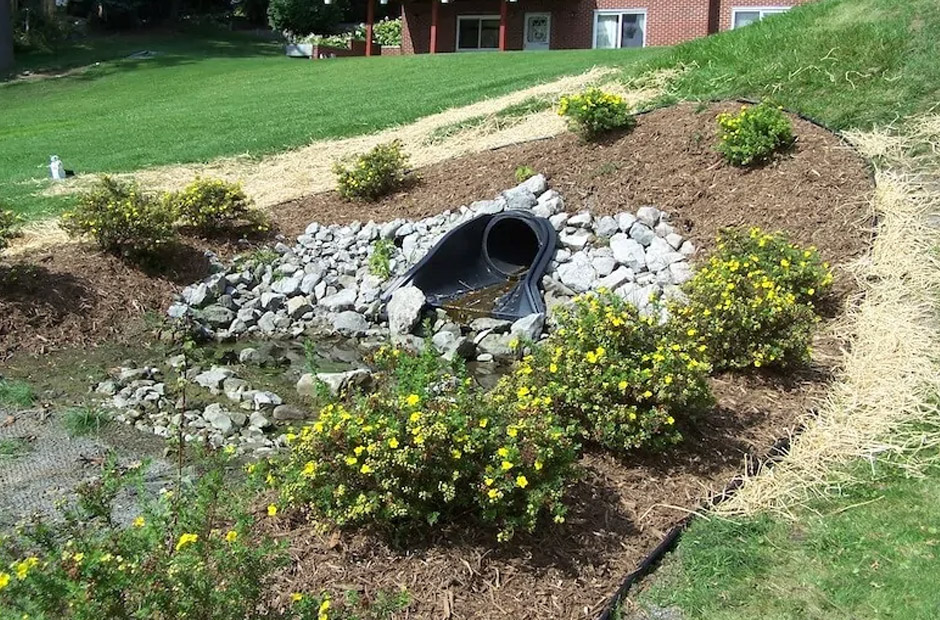
Many residential landscapes are shaped with the flow of water in mind. It’s not immediately apparent in most cases, but carefully positioned drainage lines gently direct water to the best landscape features – one of those for-your-eyes-only elements that only the homeowner ever really sees. Treatment trains, bioswales, rain gardens, and vegetative edge treatments can often be integrated elegantly into garden beds, borders, and hedges. This actively viewable element adds value to the landscape investment.
Start at the roof and work down
Before water touches your garden beds, it moves off your roof in volume that most people underestimate. A typical 2,000-square-foot roof can produce approximately 1,250 gallons of water during a single one-inch rainfall. That’s not a trickle through a downspout – it’s a surge that, without proper management, will find the path of least resistance and usually damage something.
Your gutters and downspouts are the first link in the chain. What connects them to your ground-level drainage strategy matters. Decorative rainwater heads sit at the top of downpipes to filter debris and control the initial flow before water enters a tank, rain garden, or dispersal system. They’re also a visible architectural element on the exterior of your home – a detail that signals a considered approach to the whole system.
Getting this junction right is the difference between a drainage plan that holds up and one that overwhelms downstream features every time it rains heavily.
The dry creek bed as a functional focal point
Once the water gets to ground level, you need to decide where it will go. And one of the most elegant and effective ways to get rid of it is to send it on its way in plain sight, through a dry creek bed.
A dry creek bed is nothing more than a channel – lined with river stones, boulders and low planting – that looks like a natural watercourse. When it’s dry, it reads as a landscaped feature. When it’s wet, it’s doing its job. Water is running through it in a directed fashion toward a collection or infiltration point, but your garden doesn’t look like a drainage project, it looks like an intentional design.
For a sloped property, this works well with terracing. When you build walls to break a slope into level areas, you also break up the surface flow that is racing to the bottom of the hill, carrying soil with it. Erosion control and visual organization are two sides of the same coin.
Rain gardens and the plants that make them work
A rain garden is like a sponge that soaks up stormwater. It can help clean the water, too, if it is designed and built well. The basic idea is simple: it’s a depression planted with the right species where rainwater from your roof, driveway, or patio can go instead of running into the storm drain. It holds the water temporarily and allows it to soak in, and ideally, to be cleaned by soil and plants before it does.
A garden of any sort can’t be an efficient sponge if it’s not populated with species that support that function. In the case of a rain garden, stick with those that do two things: drink up lots of water, fast, and hold the soil while doing it. In a successful rain garden bed, they’re also native species that look good all year long.
Deep, fibrous roots spread quickly through the soil and are the best at stabilizing the soil. That’s something many of these plants have in common. Many of them, especially the grasses, also put up with regular wet-dry cycles in ways that ornamental species won’t. A long dry week followed by a deep rain, then repeat – the ornamentals die out in those conditions, while the real workhorse species chug along beautifully.
Permeable surfaces and hardscape choices
Areas frequently used, such as driveways, paths, and patios, are responsible for most of a property’s impermeable surface area. Water reaches concrete surfaces and immediately turns into runoff, highlighting that hardscaping choices are as essential for stormwater management as the selection of plants.
Permeable paving alternatives have advanced significantly. Gravel, decomposed granite, open-cell pavers, and spaced stone with planted joints enable water to percolate downward instead of spreading horizontally. They are not all appropriate for every requirement – a drive with heavy loads asks for something distinct from a garden path – but the concept of promoting infiltration wherever foot traffic or vehicle pressure permits it holds true.
A French drain can manage the excess of any of these designs: a gravel-packed trench that intercepts water at a low spot and carries it away from the foundation. It will go unnoticed, but it is part of the underground assistance that enables the visible pieces to work when the going gets tough.
Overflow is part of the plan
No system handles every situation. Planning for overflow – understanding where the water will go when your rain garden is full or your tank is overflowing – is the difference between a system that functions when you need it the most and one that doesn’t. This may include a secondary exit, a higher berm, or guidance to a storm drain on the street. The critical factor is that overflow is a part of the plan and is managed, not just left to find its way through your garden.
Water flowing through a backyard doesn’t have to be hidden and managed out of sight. The more openly you recognize it, the better your solution will look.