Many people think that tooth loss is inevitable, and that it is primarily due to bad luck, accidents, or genetic predisposition. However, this is not usually the case. Most of the time, the loss of a tooth is the result of an untreated condition that began with the lack of a simple dental check-up many years before.
Why Teeth Actually Go Missing
Two conditions account for almost all adult tooth loss: periodontal disease and tooth decay. Neither shows up overnight. Decay works its way through enamel slowly, and gum disease usually starts as gingivitis, a mild inflammation of the gum line that’s completely reversible if it’s spotted in time. Left alone, gingivitis progresses into periodontal disease, which attacks the bone and ligament holding the tooth in place. By the time a tooth is loose enough to need extraction, the damage has been building for years.
This is the part that gets lost in most conversations about tooth replacement: prevention and restoration aren’t separate topics. They’re two ends of the same timeline. A dental health checkup does the diagnostic work – dental X-rays reveal bone loss and hidden decay long before you’d feel anything – and that’s exactly the point where most tooth loss could have been stopped. If you’re reading this because you’ve already lost a tooth, it doesn’t mean you did anything wrong. It just means the window for prevention closed, and now it’s time to think about restoration instead.
What Happens If You Leave A Gap Unfilled
An empty socket is anything but silent. The jawbone in that area only remains solid because a tooth root is engaging with it every time you bite or chew. When that stops, the bone begins to resorb, shrinking in width and height within just a few months. This is why delaying treatment for a lost tooth can make things complicated – there might not be enough bone anymore to even support an implant without grafting.
The teeth around the hole aren’t dormant, either – they begin to drift into the empty space. This can force other teeth out of alignment and interfere with your bite, which can lead to TMJ disorder and other problems. The opposing tooth in the other jaw, with nothing left to bite against, can begin to over-erupt, extruding itself out of the gum or driving itself deeper in search of new contact. All of this adds up to something called bite collapse and it’s one of the main reasons for difficult and expensive treatment in people with multiple missing teeth. It also puts too much pressure on the teeth that are still in a healthy position.
Comparing Your Three Main Restoration Options
If you decide to have a tooth replaced, there are three general routes you can take, and with each come real trade-offs.
The least invasive and generally cheapest are dentures, whether partial or full. No surgery is required for them, which can make them the best choice for patients who aren’t good candidates for any kind of surgery or who can’t tolerate sedation. The downside of dentures is stability. They simply sit on the gum, so they can slide around while you’re eating or talking. You could also take them out at night and leave them in a glass of water. Most people will need to reline or replace them every five to eight years because of the continuous resorption, or shrinking, of the jawbone that happens without a natural root there.
A dental bridge fills the gap in your teeth by anchoring a false tooth to the natural teeth on either side of the gap. Those teeth support the crowns that hold the bridge in place. The upside is this can be a stable solution. It doesn’t shift. The downside is that you’ve got to grind down two perfectly healthy teeth to build the crowns necessary to support this restoration. They’re permanently damaged, and the additional force of holding your missing tooth can make them more likely to fail. And the fate of your bridge is tied to the fate of the teeth that are holding it. If one of them decays or becomes infected, the whole bridge likely needs to be replaced.
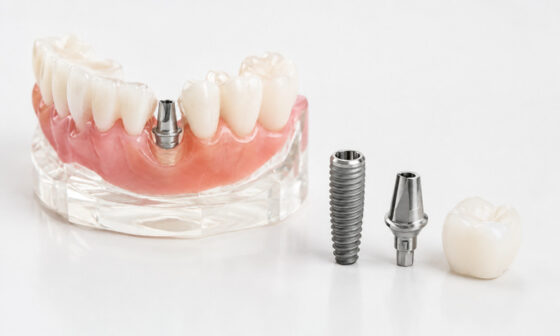
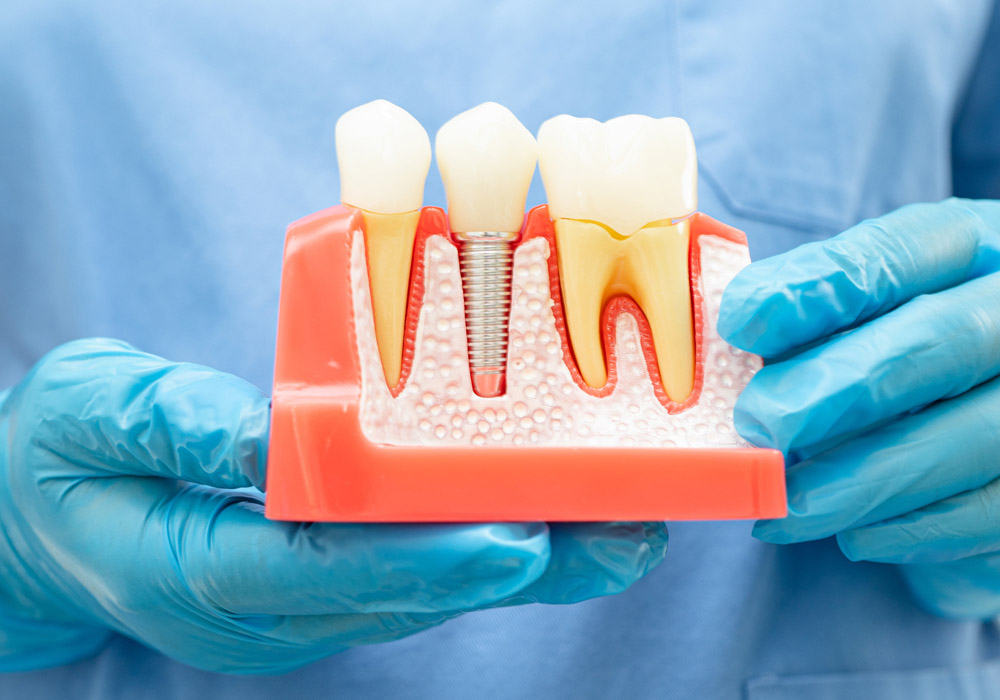
Dental implants are the closest thing to getting your natural teeth back because they replace the root and the crown separately. A titanium post is drilled into the jawbone, and, after a few months, when the post has fused with it, a crown is cemented on top. There is nothing attached to other teeth, and there is no reason to take them out at night.
Why Implants Are Treated As The Gold Standard
Implants are more effective than bridges and dentures because of osseointegration. Bone cells grow directly onto the surface of the titanium post over months, connecting the implant to the jaw like a natural root. This fusion does two things bridges and dentures cannot. It restores the stimulation that prevents jawbone shrinkage, and it provides the crown with the stability a natural tooth root would offer.
These benefits are reflected in the numbers. The American Association of Oral and Maxillofacial Surgeons reports that dental implants have an approximately 95% long-term success rate over 10 years. This makes them the most reliable tooth replacement option now available. No other type of restoration even approaches that percentage over a decade.
Are You Actually A Candidate?
Not everyone can walk in and get an implant placed the same week. Candidacy depends on a few things a dentist needs to assess properly, not guess at.
Bone density is the big one. If too much resorption has already happened, there may not be enough bone to hold the implant post securely, and a bone grafting procedure might be needed first to rebuild the site before placement. Gum health matters too – active periodontal disease needs to be treated and stabilised before implant surgery, otherwise the same bacteria that caused the original tooth loss can compromise the implant. Systemic conditions like uncontrolled diabetes can slow healing significantly, and smoking is one of the biggest risk factors for implant failure because it restricts blood flow to the healing site.
None of this means implants are off the table for most people. It means the assessment stage matters as much as the surgery itself. This is exactly why choosing an experienced provider for the consultation and placement process makes a real difference to outcomes, and it’s the kind of thorough evaluation you’ll get from a practice like The White House Dental Practice, Wirral, where candidacy is properly checked before anything is decided rather than assumed.
Dental anxiety keeps a lot of people from even getting to this stage. If that’s part of why you’ve delayed treatment, say so at the consultation. Most practices have ways to manage it, and the assessment itself is far less invasive than people expect.
What The Implant Process Actually Looks Like
The timeline surprises many new patients because while it’s longer than they might expect, it’s also far less uncomfortable than they’d feared.
You’ll first come in for a consult and 3D scan, which gives your dentist a precise map of your jawbone, nerve locations, and existing teeth. If bone grafting is necessary, that’s its own phase and healing timeline before you’re ready to proceed any further. When the site’s prepped, your implant post is placed in a short outpatient surgery under local anaesthetic, and then comes the patience part: approximately three to six months to give your jaw and post time to fuse naturally.
Only after your dentist verifies this fusion during a check-up can the crown go in on top. If bone grafting is part of your process, it could be close to a year from step one to final step. Simple single-tooth cases take less time.
Talking Honestly About Cost
Dental implants do cost more than a bridge or a denture, and it would be disingenuous to suggest otherwise. However, the comparison shouldn’t end with the initial bill. Dentures typically last five to eight years before they need replacing or relining. Bridges last ten to fifteen years before the supporting teeth or the bridge require replacement. An implant that is correctly integrated, and then properly cared for, can last many decades; in some cases, it can last a lifetime.
When you tally the cost of replacing a denture three or four times over a thirty-year period, the difference between “expensive” and “affordable” becomes much narrower. It’s a choice that encourages thinking in decades rather than thinking about the next bill.
Restoration Isn’t The End Of The Story
Regardless of which alternative you go with, the upkeep doesn’t end after the fix is in place. Dentures must be cleaned daily and frequently refitted. Bridges demand more diligence in flossing under the connection area to avoid decay in the anchor teeth. Implants demand the same oral care, for the reason that the gum tissue surrounding them can develop something much like gum disease referred to as peri-implantitis, and the implant is in danger of being lost if left untreated.
Which pretty much sums it all up; regular dental maintenance isn’t just what keeps you from losing your teeth to begin with. It’s also what protects whatever replacement you ultimately select. Implants, bridges, and dentures all benefit from the same regular professional maintenance that caught, or should have caught, the problem in the first place.
Where To Start
If you have lost a tooth, or you have been informed that you are likely to lose one, the best course of action is not to start researching implant companies or looking at prices online. The best thing to do is schedule an examination so that your bone density, gum health, and remaining teeth can be evaluated, and you can be told what your real options are.
Chewing function, speech function, and confidence are all compromised when a tooth is lost and remains unreplaced. None of that has to be a reality, but you must start by obtaining the facts before you make any decisions.