When a TIG weld fails inspection, most welders reach for their settings first. That’s the last place you want to look. Instead, get predictable results by following a logical sequence of inspection, testing, and adjustment for gas delivery, electrical parameters, operator variables, and machine problems. Fix the likely cause first. Then, instead of fussing with settings at random, use weld testing to gradually optimize for the best results.
Diagnosing Porosity and Gas Coverage Failures
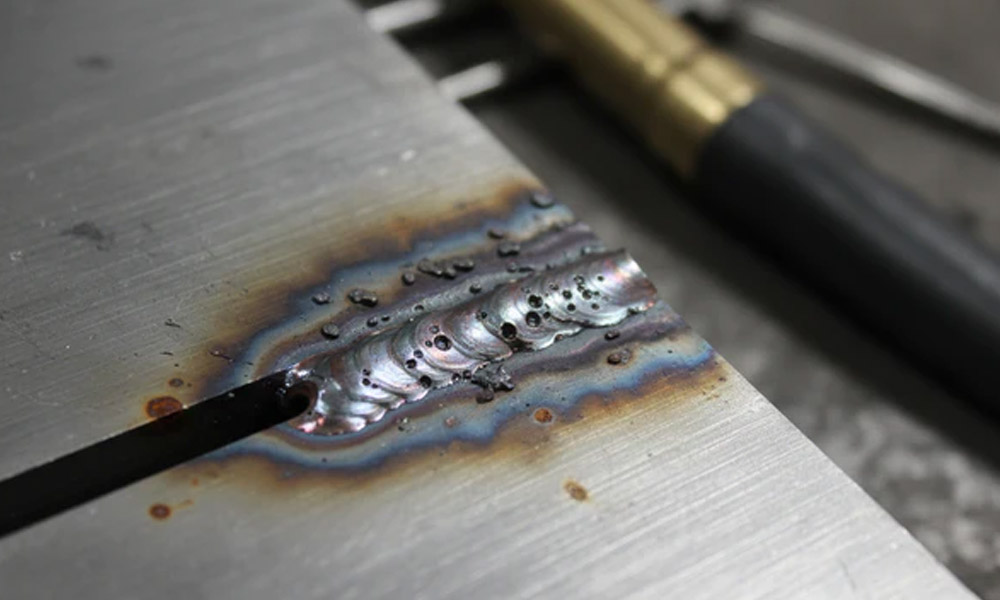
Tiny gas pockets that are contained within the weld pool are often indicative of shielding issues. If there’s porosity in the weld, the instinct is to assume the cylinder is running dry. But even if the flow doesn’t appear drastically low on the regulator, shop drafts, an open bay door, or a nearby fan can collapse the gas envelope and lead to contamination. A simple gauge of whether environmental air is spiking gas flow is to hold a flat ring of cardboard half an inch from the arc during a weld. If the cardboard flutters, there’s too much airflow in the environment to get an accurate reading on the meter.
Torch hardware issues are another common source of contamination and porosity. Cracked ceramics, warped collets from overtightening during set-up, and degraded O-rings are all easy fixes, but keep atmospheric air from getting to the gas stream before it even leaves the handle. A collet that’s even slightly out of round won’t grip the tungsten smoothly, meaning there’s turbulence in the gas stream. The shield gas will be erratic and uneven.
Gas lenses provide laminar flow and allow contractors to use more than 95 percent of the gas purchased. The old collet body/tungsten setup only lets you use 65 percent of that shield gas at the high end of the cup. I use one whenever possible on stainless steel pipework or any other type of work where getting gas coverage can be problematic.
Lastly, fiddling with the post-flow settings on the machine is a quick, cheap fix to extend welding gas. The general rule is one second of post-flow for every 10 amps of welding current. The tungsten and weld pool are still oxidation-prone even after the arc stops. If the gas isn’t flowing after the arc goes out and the weld is allowed to cooldown, the color at the end of the weld turns dark black, the tungsten turns mushroom gray, and has to be grinded more.
Hardware Failure as a System Variable
If after ruling out gas and technique problems, instability issues still plague your welding operation, the next step in the troubleshooting process is to isolate the components you’re using as variables. Procurement teams can browse A large selection of TIG Torches online to match replacements to specific power source ratings and duty cycles, rather than substituting whatever’s in the consumables cabinet.
For example, the most common cause for persistent arc instability has nothing to do with gas or technique, it’s that the machine’s torch has been repeatedly dropped, damaging its internal threads. In addition to the torch itself, a few other parts are generally swapped as a unit. This way, you can determine if the entire torch head is at fault.
Tungsten Contamination and Arc Instability
Dirty tungsten electrodes can be very obvious when welding: an erratic wandering arc that has a hard time maintaining a constant shape. Most of the time, there’s been some physical contact between the electrode and either the weld puddle or the filler rod that caused the contamination.
Prevention starts with good arc gap discipline, an arc gap of 1/8 inch or less. High-frequency starting also helps because it keeps you from having to touch-start which is the easiest way to get tungsten embedded in the weld. When it happens, the electrode has to be removed, re-ground longitudinally (never radially, that leaves circumferential grooves that can upset gas flow), and checked for cracks before re-use.
Polarity also comes into play here. You want to use DC electrode negative for steel and stainless. Aluminum needs to be AC because the positive half-cycle cleans the oxide. Run the wrong polarity on aluminum and you get the contamination that looks like tungsten inclusion but isn’t.
Undercutting and Lack of Fusion
These two issues are similar but they are not the same thing. Undercutting, the valley at the weld toe, is caused by too much amperage or travel speed, which melts the base metal and wets in insufficient filler. Lack of fusion occurs when the arc does not melt the edges of the joint because speed is too high or the torch bent too far.
For a TIG weld, use a 15-to-20-degree push and move the torch. More than that and you’re moving heat away from the puddle of molten metal. Less than that and you can’t see and the gas isn’t protecting the front of the puddle. When undercut appears regularly on one side of the weld, torch angle is just about always the cause. If you see lack of root fusion, slow down and take a look to make sure that the heat-affected zone on each side of the weld is symmetrical before you resume welding.
Locking Out the Root Cause
Troubleshooting welding problems isn’t a linear prospect in high-product-mix/low-volume job shops. Porosity can be caused by gas, hardware, or environment. Undercutting can be caused by amperage, speed, or angle. And, of course, these may not be independent variables. A systematic sequence for beginning diagnosis of welding anomalies, that is, gas delivery, then electrical parameters, welding technique, welding hardware, keeps the effort from devolving into wild guessing and, later, keeps the job shop from depending on tribal knowledge or temporary adjustments that no one bothers to write down.