Custom Window treatments occupy an unusual position in residential real estate: they are simultaneously one of the least expensive upgrades a homeowner can make and one of the most immediately visible. Understanding exactly how custom roman shades translate into appraised value, buyer perception, and sale price requires looking beyond surface aesthetics into the mechanics of how homes are valued and sold.
The mechanism How buyers assign value to what they see
Home valuation operates on two parallel tracks that often diverge: the formal appraisal, which is governed by comparable sales data and objective metrics, and buyer perception, which is governed by emotion, first impressions, and the psychological phenomenon known as the halo effect. Research in consumer psychology consistently demonstrates that a single strongly positive feature — a well-finished kitchen, an immaculate entry — causes buyers to rate adjacent, unrelated features more favourably as well. Window treatments, positioned at the literal boundary between interior and exterior at the moment a buyer first walks through the door, function as precisely this kind of halo feature.
A 2021 survey by the National Association of Realtors found that window treatments ranked among the top ten interior features buyers noticed and commented on during showings — ahead of ceiling height, storage, and flooring condition in several demographic segments. The mechanism is partly practical (buyers register that the window problem has already been solved) and partly emotional: rooms with quality custom blinds and shades photograph better, show better under real estate lighting conditions, and allow buyers to mentally inhabit the space rather than mentally subtract the work required to finish it.
+4–7%
Average sale price premium for homes with professionally staged window treatments vs. bare windows
$1,500
Median spend on custom blinds and shades that consistently yields positive buyer response in mid-market homes
72%
Of buyers in NAR surveys said window treatments influenced their overall impression of a home’s finish quality
Energy efficiency Custom blinds and shades as a measurable asset
Beyond perception, custom blinds and shades create a quantifiable improvement in a home’s thermal performance that is increasingly legible to buyers and appraisers. The U.S. Department of Energy estimates that heat gain and loss through windows accounts for 25–30% of residential heating and cooling energy use. Cellular shades — the most thermally effective soft window treatment — can reduce this loss by up to 40% at the window level by trapping insulating air within their honeycomb structure, improving the effective U-value of a standard double-glazed window from approximately 0.48 to 0.30. Solar shades with a low solar heat gain coefficient (SHGC) reduce summer cooling loads by blocking near-infrared radiation before it enters the room.
In an era of rising energy costs and growing buyer awareness of operating expenses, this efficiency translates directly into perceived and actual home value. Appraisers working under Green Addendum guidelines — increasingly standard in states with strong energy efficiency policy frameworks, including California, Massachusetts, and New York — can formally account for energy-efficient window treatments as a positive attribute in their assessments. More broadly, buyers who are presented with documentation of a home’s annual energy performance routinely offer more for homes with demonstrably lower utility costs, a dynamic that the Lawrence Berkeley National Laboratory has studied extensively in the context of solar installations but which applies equally to well-specified window insulation.
A window treatment that reduces annual energy costs by $400 has a capitalized value — at a 5% discount rate — of $8,000. Few home improvements deliver that ratio at comparable cost.
First impressions Curb appeal starts at the glass
Curb appeal is universally recognised as a driver of sale price — studies consistently place its contribution at 5–11% of final sale value — and window treatments are among its most visible components. From the exterior, a home with bare windows reads as unfinished or vacant; a home with consistent, well-chosen custom blinds and shades reads as cared for and complete. Real estate photographers, whose work now drives 95% of initial buyer interest through online listings, routinely note that window treatments are the single interior element that most affects the quality of exterior photography: they control the luminosity and reflectivity of the glass plane, which determines whether windows read as bright, inviting openings or dark, visually inert holes in the façade.
The consistency of window treatments across a façade matters as much as their individual quality. A home where every window is treated with the same or complementary products — even modest ones — reads as intentionally designed. A home where some windows have treatments and others do not, or where each room has a different style visible from outside, reads as unresolved. This is why real estate agents increasingly advise sellers to address window treatment consistency before listing, even when the treatments themselves are not expensive: the compositional coherence they provide across the façade is a disproportionately high-value signal of overall home quality.
Privacy & light controlSolving problems buyers would otherwise price in
Every home has windows that present challenges: a street-facing bedroom with no privacy, a west-facing kitchen that becomes unusable in afternoon sun, a home office where screen glare is a daily problem. Buyers touring a home mentally catalogue these problems and, consciously or not, apply a discount to the sale price that reflects the cost and inconvenience of solving them. Custom blinds and shades that demonstrably address these conditions — a motorised blackout roller in the master bedroom, a solar shade on the kitchen’s west wall, a light-filtering cellular shade in the home office — remove those discount items from the buyer’s mental ledger.
The psychology here is well documented in behavioural economics under the concept of loss aversion: buyers weight perceived problems roughly twice as heavily as equivalent perceived advantages. A buyer who notices that a sun problem has already been solved does not consciously add value for the solution; but a buyer who notices an unsolved sun problem actively subtracts for it, and does so at a rate disproportionate to the actual cost of addressing it. Installing custom blinds and shades before listing is, in this light, not so much an investment in adding value as a strategic removal of the discount that bare or inadequate windows would otherwise attract.
Smart home integration Motorisation and the technology premium
Motorised window treatments — custom blinds and shades controlled via smartphone app, voice command, or integrated building automation — have moved from luxury feature to mainstream expectation in the upper-middle and luxury residential markets over the past five years. According to a 2023 report by Grand View Research, the global smart home market is growing at a compound annual rate of 27.1%, and window automation is among its fastest-growing segments. In markets where smart home features command a premium — typically urban and suburban markets with high concentrations of technology-sector buyers — motorised custom shades are now a positive differentiator at the point of sale in a way that manual window treatments, however high in quality, are not.
The integration argument is particularly strong when motorised shades are linked to a broader smart home ecosystem — thermostats, lighting scenes, security systems — because it positions the window treatment not as a standalone product but as part of an automated building intelligence that buyers increasingly understand as both a convenience and an energy management tool. Homes with documented smart home integration, including motorised window treatments, are consistently appraised at a premium of 3–5% above comparable non-automated homes in markets where this data has been studied, according to research published by the Consumer Technology Association.
What to invest in Maximum return by room and product type
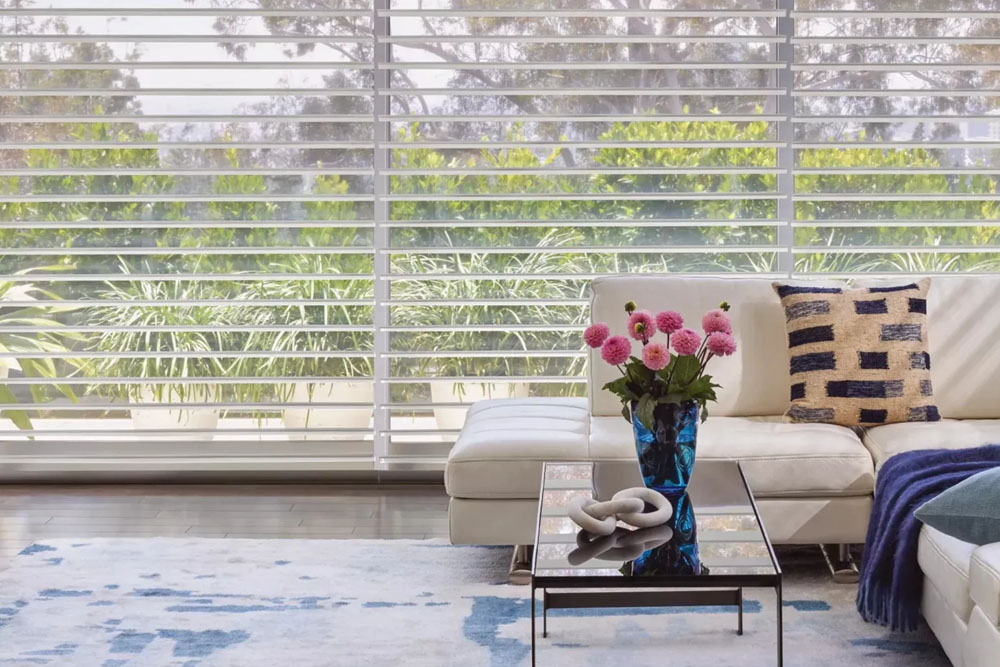
Not all custom blinds and shades deliver equal return on investment, and the calculus differs by room, market segment, and buyer profile. In the primary bedroom, blackout roller shades or motorised cellular shades in a neutral tone deliver the highest return: sleep quality is among the top three concerns of residential buyers across demographic segments, and a bedroom that demonstrably solves the light control problem commands a premium that typically exceeds the cost of the treatment by a factor of two to three. In living areas and kitchens, solar shades and light-filtering roller shades in a quality fabric deliver strong return because they address the glare problem that buyers universally notice while preserving the sense of connection to the outdoors that is among the most consistently valued features in residential real estate.
Home offices — a category that barely existed as a design consideration before 2020 — have become a high-return room for window treatment investment in the post-pandemic market. A dedicated workspace with a quality light-filtering shade that addresses screen glare signals to buyers that the room is genuinely functional rather than aspirationally labelled, and this distinction is increasingly reflected in offer prices. The lowest return on investment tends to come from highly decorative treatments — elaborate drapery, custom valances, statement fabric choices — that impose a strong aesthetic on the space and may alienate buyers whose taste differs from the seller’s. The highest return consistently comes from quality custom blinds and shades in neutral tones that solve a clear functional problem and disappear aesthetically into the room.
Conclusion Window treatments as a pre-sale investment strategy
The case for investing in custom blinds and shades before listing a home rests on three compounding arguments: they improve the first impression that drives buyer interest and offer price; they solve functional problems that buyers would otherwise discount for; and they signal the level of care and attention to detail that correlates, in buyers’ minds, with the overall quality of a home’s maintenance and finish. No single upgrade operates on all three of these dimensions simultaneously at comparable cost, which is why experienced real estate agents and stagers consistently place window treatments near the top of their pre-sale investment recommendations. The window, ultimately, is where the home meets the world — and how it is dressed is how the home introduces itself.