The reason most adults quit tennis early isn’t that they lack some magical coordination gene. It’s because we make them take lessons from a teenage version of themselves – and with a wildly different life, body, and brain to the one the beginner is working with.
You didn’t miss your window
The idea that it’s too late for adults to develop major new skills is a myth. Neuroplasticity doesn’t stop at age 18, or 30, or 50. It might slow down in some aspects, but it’s still there: you’re still building new brain material every time you practice or learn something.
Where kids have an edge is pure lack of fear: they swing through a shot without the least worrying about missing, looking dumb, or the ball going into the stands. An error rolls off a kid’s shoulders in about half a second. An adult? That error restarts the brain loop about backswing, follow-through, elbow position, tension, and so on.
Give a 10-year-old an adult-sized tennis racket and, yes, the little guy will hit a thousand more balls out of court than they do with their dinky little racket. But give an adult an actual reason to aim, and they’ll catch up quickly. They can do the “Ok, I noticed why that went long, let’s taper the follow-through” thing a lot into fewer balls.
Why the first few weeks feel impossible
Watching a rally may give you the impression that it is not mentally invigorating. In reality, however, focusing on a rally requires a lot of mental energy on the part of a beginner player. Your feet are constantly moving, you’re reading your opponent, guessing the direction and the power behind the next shot, you’re trying to remember what your coach said about your technique, and so on. Your brain is running in overdrive and after a while, you feel like you’re done for the day, when in reality you might have spent only 30 minutes on the court. It’s quite a challenge to go over all these activities and to optimize them at the same time and that challenge is often underestimated.
Tennis as a fitness routine, not just a sport
This is the part that will make you reconsider committing to this. Tennis is not just a game that you’re acquiring – it’s one of the best exercise regimens available to a time-crunched adult, and the science confirms that. The Copenhagen City Heart Study, published in Mayo Clinic Proceedings, followed recreational athletes over multiple decades and found that tennis players live an average of 9.7 years longer than non-players. In the same study, cyclists lived an extra 3.7 years, swimmers 3.4 years, and joggers 3.2 more not-quite-as-much-time-on-this-earth years.
Part of the reason tennis delivers that return is that the movement is the workout: a point can last four to fifteen seconds of all-out effort, followed by a brief rest, then it’s another maximal effort. That’s interval-style cardio, designed into the game rather than something you have to replicate on a treadmill. And if you’re in the Roseville area looking for a place to start building this habit, Roseville Tennis by Evolve Tennis Academy is a solid option for getting proper coaching from day one. You are engaging your legs, core, and rotator cuff on nearly every shot, making it a full-body workout dressed up as a game you keep turning up for. Most workout routines fail because they’re boring. Tennis solves that problem by making the exercise an accidental byproduct of something interesting.
A weekly rhythm that won’t wreck your body
Adults need to follow a structure that kids do not. To clock a week that doesn’t result in injury or burnout, plan for two to three on-court sessions, all preceded by a proper mobility warm-up and followed by a cooldown (ten minutes of core work then some quad and hamstring stretches on the living room floor will do wonders). The other “on” days involve strength work that should be customized to where you are in your tennis life and how hard you’ve been hitting your serves and forehands.
The meat of the week is in the off days. Two days a week of focused, no-more-than-30-40-minute strength work, plus 20 minutes of core, glute, and leg work each on-court day will pay more immediate dividends in terms of staying healthy and preventing injury than dialing down the serve. Focus on the muscle groups you don’t feel enough during your game or that lead to the small twinges normalized as “millennial pain.”
Build muscle memory before you chase rallies
One of the most frequently made mistakes by adult beginners is that they attempt to rally too soon. Rally play is a mess – the ball comes back differently every time, and you can’t isolate what you’re trying to fix. Adults make faster progress with contrived practice: basket-fed repetition, dead-ball drills, and shadow swings where the only thing changing is your own technique.
That’s how you build muscle memory – the kind of repetition-driven encoding that eventually lets you hit a forehand without deliberately thinking through five steps. Once that encoding is there, your brain is not controlling the stroke but the point. That’s the real turning point in early development, and it almost always comes from structured repetition rather than unstructured rally attempts.
The serve deserves its own timeline
The serve is often the most challenging stroke for adults to learn in tennis. It’s a movement that involves the entire body and, therefore, is quite complex and difficult to master. However, by breaking down the serve into smaller components and practicing each one separately, you can improve your overall serving technique.
To begin, focus on your stance and your racquet grip. Make sure you feel comfortable with both, as they will determine the power and accuracy of your serve. Next, practice your toss. Your toss should be high enough that you can make contact with the ball at the highest point of your reach, and consistent enough that you can place the ball on the right side of your body with your eyes closed.
Once you feel confident with your stance, grip, and toss, begin focusing on the trophy position. The trophy position is important because it sets up your body for the most efficient striking of the ball. Finally, work on your swing. Make sure your swing is continuous, and that you snap your wrist at the point of contact for maximum velocity.
Injuries are a technique problem, not an age problem
Lateral epicondylitis, also known as tennis elbow, is the injury that more than any other has been associated with adult starters, and from which most people logically assume that it comes with age. But it doesn’t. Practically all of these cases will have been caused by late contact, over-gripping the racquet, or poor mechanics of the stroke, which put repetitive strain on the forearm tendons – age be very. Fix the technique and the injury risk drops substantially, no matter what age you are.
The same goes for rotator cuff irritation, where again serve mechanics, rather than usage, is the cause. This is the strongest argument for getting your technique right away rather than starting off with a bad habit that will cost you a small era recovering later on. Technique-first coaching is not about vanity of style on court, it’s injury prevention with the frills of better shots.
Equipment that matches an adult body
Equipment is more important for adults than for kids since your body has less capacity for compensating for bad mechanics or for the wrong equipment. A racquet in the 270 to 300 gram range, strung at a moderate tension, with a properly fitted grip size, reduces the shock transferred to your elbow and shoulder on off-center hits. Too light and the racquet twists on contact, which stresses the arm. Too heavy and you’ll start compensating with bad mechanics by your third set.
Shoes are every bit as important as the racquet, maybe more. Tennis is full of lateral movement and quick stops and running shoes don’t have lateral support. A pair of actual court shoes will save your ankles and knees over a season of play. None of this needs to be expensive. It needs to be right for your body, not just what was on sale.
Why coaching beats teaching yourself from videos
Many people are drawn to learning tennis from free videos, but for certain sports that’s not a problem. Tennis happens to be one of those sports where it is extremely difficult to identify the proper stroke mechanics on your own. You cannot, in real-time, see your contact point, your weight transfer, or your racquet face angle. Plus, video tutorials cannot make corrections to your swing as you are in the middle of it the way a coach can.
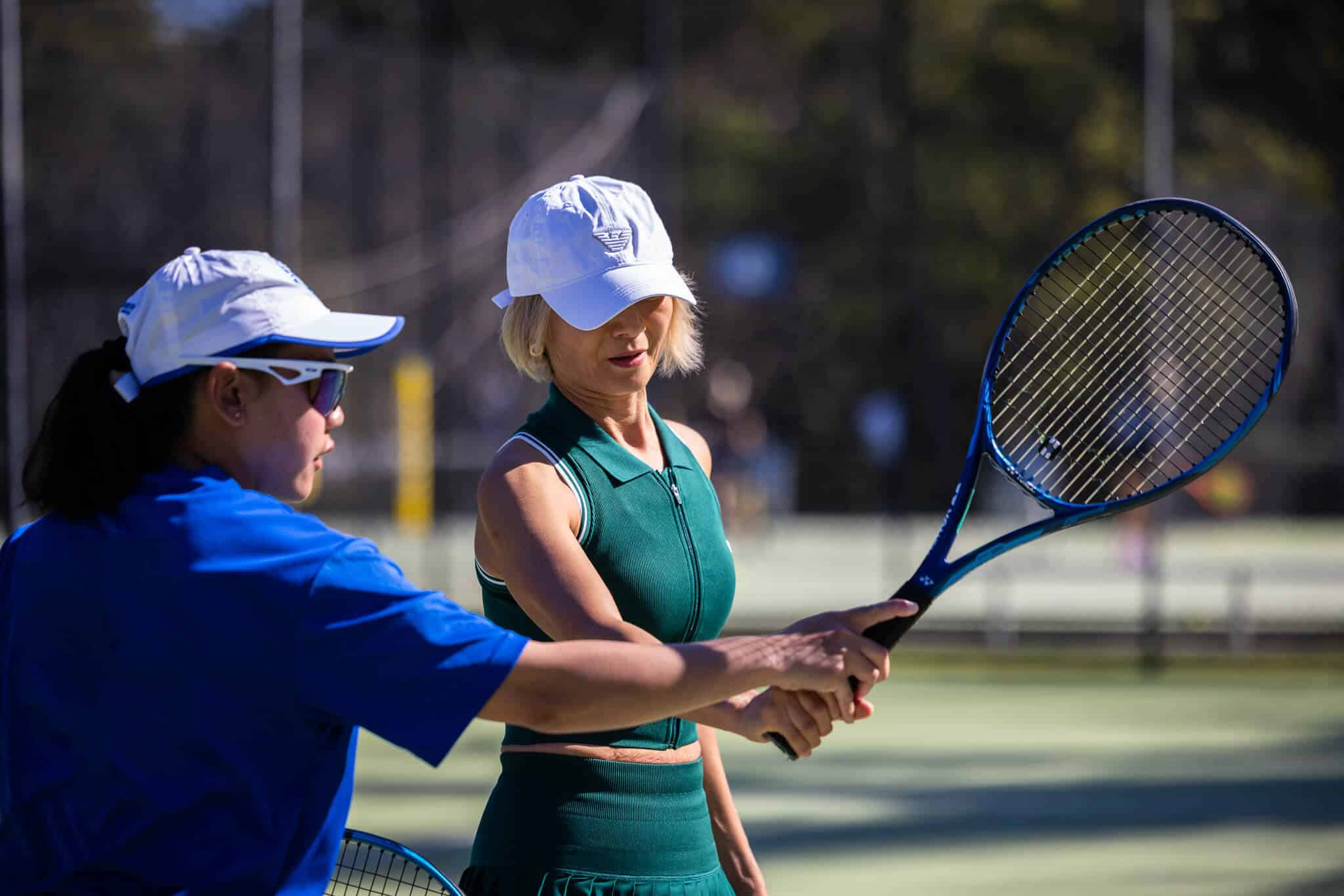
For adult beginners, the optimal path is private or semi-private lessons first in order to establish proper mechanics as you build muscle memory with immediate feedback to make any needed corrections. Group clinics are next to develop your court sense, movement patterns, and point strategy against various opponents. Lastly, social matches come when those mechanics are so automated you feel like you’re not having to relearn how to swing every time you hit a ball.
Private coaching early on is not a luxury, it is the single biggest factor for eliminating as much of the learning curve as possible and avoiding the injury that comes from self-taught mechanics.
What a realistic first season looks like
It’s important to set realistic expectations before you begin because unreasonable expectations are what drive adults to give up after two months. The reality is that most beginners require somewhere between eight to twelve classes to start rallying confidently. That’s not a slow process, it’s a standard one. This applies to most adult learners, regardless of their overall level of fitness.
Instead of waiting for a big breakthrough, focus on small achievements. Hitting ten rally balls in a row without an unforced error is an achievement. Winning your service game in a practice match is another. These are the kind of achievements that count because they are the things that will inspire you to keep going even when you feel you are not improving from week to week.
Make the social contract work for you
When adults do stick with fitness, it’s often because there’s something external on the line. A booked court time with a coach, a standing clinic slot, a friendly ladder match with someone who’ll notice if you cancel – these exert an accountability willpower alone rarely matches. This is also one of the quieter benefits of tennis as a long-term fitness routine: it builds a social structure around the exercise, which is exactly the thing most solo workout plans lack.
Age isn’t the barrier here. The barrier is training like you’re still ten years old, expecting instant comfort, and quitting when the cognitive load doesn’t disappear in two weeks. Give it the structure it actually needs, and the sport will give back a fitness routine that’s hard to replace – and, if the Copenhagen data holds any weight, a few extra years to enjoy it.