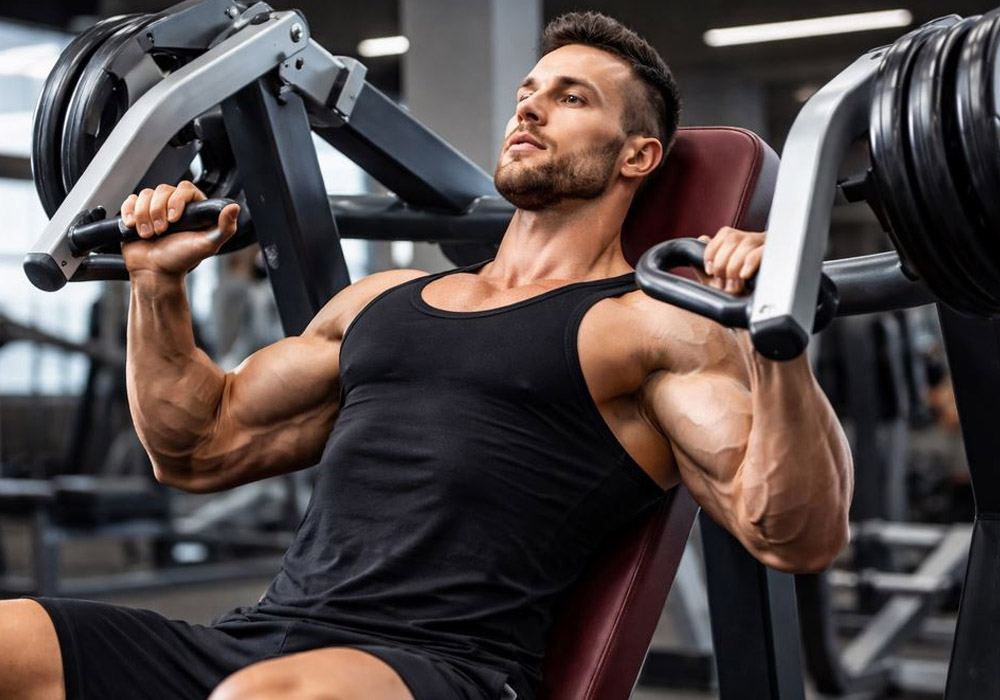
Many individuals who have been performing the bench press struggle to activate their chest muscles during the exercise routine. This is because the shoulder and triceps often take over the movement. The machine chest press helps to isolate the chest muscles and is more effective at targeting them compared to the barbell.
The Problem Isn’t Your Effort, It’s Your Stabilizers
When you use a barbell or dumbbells, a large part of your concentration is spent ensuring the weights are stable. Your shoulders must stabilize, your wrists must be firm, and your core must stabilize to prevent you from falling off the bench. All that mental effort is taken away from what you really want to do: contract your pecs.
That’s why so many intermediate lifters inadvertently “shoulder-press” instead of bench press. The anterior deltoids and triceps brachii are more activated in stabilization movements and will work harder if your pectoralis major doesn’t push hard enough. You can be good at bench pressing and still have a weak chest. This is a common occurrence.
A predetermined range of motion eliminates the need for all this. The machine determines the path for you. There is no balancing act, no need to remember the position of your wrists, and the weights won’t deviate from the optimal path. Your only responsibility is to push the weight and feel the muscle contracting while pushing. This is not an inferior form of training. It’s a more focused one.
Building It Into Your Routine
If you want to address a lazy chest, program the machine press first or second in a session – not after your shoulders and triceps are pre-fatigued from other pressing work. Use a slow eccentric, a brief pause at the bottom, and focus on driving through the full range.
Not every machine is created equal, but you should look for a pad angle and seat that prevents shoulder impingement and can be adjusted to get the handles at a height that lines up with your mid-pec, plus a cam that provides appropriate resistance throughout the lift. You can compare what separates a good setup from a mediocre one at chestpressmachine.com. A few minutes on this site will help you spot the difference before you ever step up to a machine.
Once you’ve spent a few weeks building that awareness, you can carry it back into your free-weight work. That’s the real payoff. The machine isn’t the finish line – it’s how you learn to feel a lift you’ve probably been doing on autopilot for years.
Constant Tension Keeps The Chest Switched On
Here’s something a lot of lifters don’t think about: with the barbell bench press, tension on the pecs drops off almost completely at the bottom of the rep (at the point where the bar touches your chest). That’s a built-in rest period, and your muscle takes it every single time.
Machine chest presses don’t give you that break. The cam and pivot design keeps resistance applied through the entire range, including the stretched position at the bottom. Your pecs stay loaded from the first inch of the rep to the last. Over a full set, that difference adds up to meaningfully more time under tension for the exact muscle you’re trying to grow.
And that matters more than people give it credit for. Motor unit recruitment isn’t just about how heavy the weight is – it’s about how long and how consistently the target muscle stays under load. A machine that won’t let your chest coast is doing some of the mind-muscle work for you, mechanically.
The Research Backs The Focus Effect
This is not just a story. In 2012, a study published in the Journal of Strength and Conditioning Research by Snyder & Fry found that pectoralis major EMG activity increased by approximately 22% in lifters when performing a pressing movement under a simple verbal cue to focus on the chest, compared to pressing without any specific focus. That is a real, measurable increase in muscle activation from mental focus alone.
Now think about which environment makes that focus easier to sustain. On a barbell, you’re splitting attention between stabilization and contraction. On a machine, there’s nothing else competing for your attention. You can direct every bit of concentration toward the sticking point and the squeeze, and the research suggests that focus alone changes how hard the muscle actually works.
Training To Failure Without The Risk
There is one more benefit that is often overlooked: security when reaching failure. When you reach the point of muscular failure with the barbell bench press and you don’t have a spotter, it can be dangerous. Many people leave one or two reps in the hole for this reason. And those last two reps are where a lot of the hypertrophy magic happens.
With the machine chest press, you can go to true failure and there’s no risk of the bar falling on you. This allows for deeper motor-unit recruitment on your last few reps, right when the chest is most fatigued and most likely to actually fire the way you want it to. Combine that with a slow 3-4 second eccentric phase, and you’ve got a setup that trains the mind-muscle connection more directly than a heavy compound lift ever could.
The Takeaway
Free weights are not bad at all, and nobody is advising you to avoid barbells completely. However, if your chest muscles have not been properly activated while doing pressing movements, a fixed path and constant tension will help activate them more effectively than simply continuing to hope that your technique will improve. Think of the machine as a diagnostic tool as much as a training tool – it shows you what a real chest contraction feels like, so you have something to chase once you’re back under the bar.
Give it a real trial before you judge it: a few weeks of focused reps will tell you more about your chest development than months of guessing ever did.