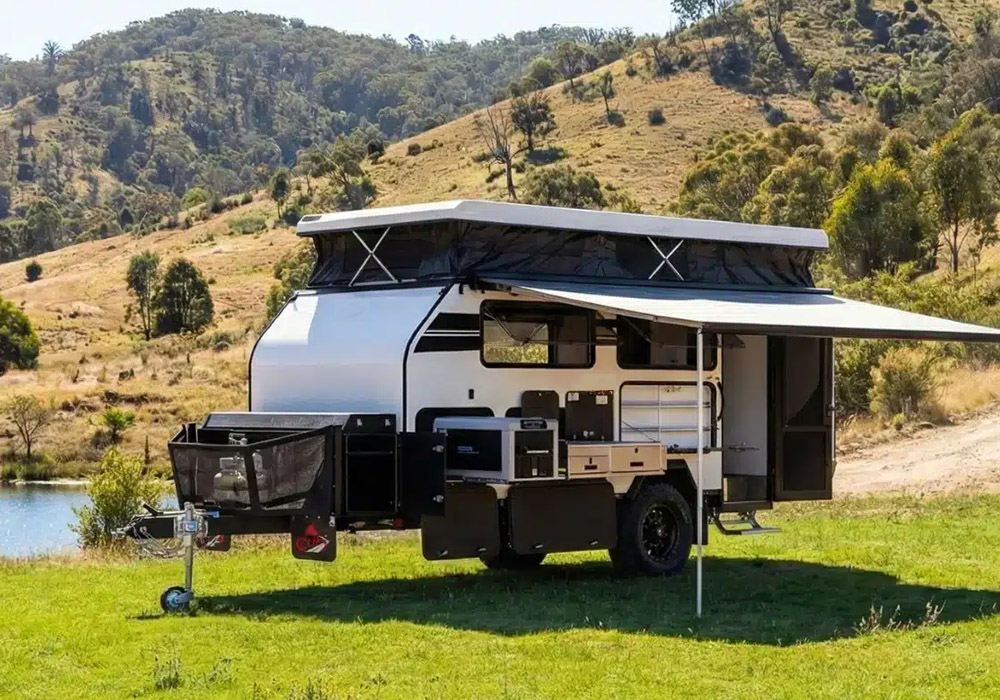
Finding a caravan that genuinely sleeps a family of four or five, tackles corrugated outback tracks without shaking itself apart, and still tows behind a mid-size 4WD is harder than it should be. Full-sized family caravans deliver the berths and the bathroom, but they punish you at the fuel bowser, demand a heavy-duty tow vehicle, and fall apart the moment the bitumen ends. Camper trailers go anywhere but leave you wrangling canvas in the rain with tired kids. For Australian families dreaming of the Gibb River Road, Cape York, or a mixed run of coastal campgrounds and high-clearance tracks, hybrid caravans in Australia have become the smart middle ground – the off-road toughness of a camper with the enclosed comfort of a van. This guide ranks the seven best options for family adventures in 2026, each judged against clear, family-focused criteria.
Our top pick is Austrack Campers for families who need to sleep four or five people in a genuine off-road hybrid without paying extra for the bigger configuration. Its Gibb 16B Family (sleeps up to four) and Gibb 16B Triple Bunk (sleeps up to five) sit at the same price point – with the full Gibb range from $68,990 to $77,990, currently on sale – so you choose the layout your family needs rather than the one your budget allows. The pop-out sections and triple-bunk build are genuine standouts at this money. For families chasing the roomiest floorplan in a bunk hybrid, BRS Platinum Pursuit is the strongest alternative. And for budget-conscious families who still want real off-road credentials, Jawa Campers is the go-to.
Below you’ll find the ranked list, a plain explanation of how we assessed each option, honest pros and cons for every brand, and a decision framework to help you land on the right rig.
At a glance
- Austrack Campers – best for families wanting two dedicated hybrid models (4- and 5-berth) at the same price point
- BRS Platinum Pursuit – best for families needing a spacious, bunk-equipped hybrid with a generous floorplan
- Jawa Campers – best for budget-conscious families wanting hard-top and pop-top options
- Opus Campers – best for families prioritising lightweight design and premium on-board features
- Windsor Rapid – best for adventurous families seeking rugged, Australian-made off-road durability
- Kimberley Karavan – best for families planning serious remote and outback touring with a custom-built hybrid
- Snowy River Campers – best for families wanting a versatile, all-terrain hybrid that adapts to varied trip styles
How we chose
A family hybrid has to do more than look the part in the dealer’s yard. We weighed each brand against five criteria that actually matter once you’re two hours down a dirt road with kids in the back.
Sleeping capacity
The non-negotiable. We favoured hybrids that genuinely sleep four or more, with a clear preference for dedicated bunk configurations that give children their own space rather than a fold-out dinette pressed into nightly service.
Off-road build
Real off-road credentials mean independent suspension – trailing arm setups and similar designs that soak up corrugations – high-clearance chassis (a gooseneck chassis is a strong indicator of serious intent), and all-terrain tyres. Lightweight aluminium body and chassis construction earns extra marks where it doesn’t compromise toughness.
Off-grid capability
Extended touring means going days without a powered site. We looked at onboard water capacity, solar and battery power provision, and self-contained facilities so families can free-camp with confidence. Many of these values echo the picks in RV Daily’s roundup of Australian made hybrid caravans for off-road adventures.
Towability
The whole point of a hybrid is that it’s lighter and more manageable than a full-sized van. We assessed whether the ATM and GTM suit a mid-size SUV or 4WD – a Ford Everest, Isuzu MU-X, or LandCruiser – without forcing an upgrade to a heavy-duty tow vehicle.
Family-friendly layout
Finally, the practical stuff: an internal bathroom or toilet, a workable kitchen, storage for a family’s worth of gear, and living space that doesn’t feel like a cupboard after a week of rain.
The 7 best hybrid caravans for families in Australia (2026)
Every rig below earns its place for a specific kind of family and a specific style of trip. The list runs from our overall top recommendation through to specialist alternatives suited to bigger budgets and more remote ambitions. If you want the shortest path to a confident decision, start at number one.
#1. Austrack Campers – Best for families wanting two dedicated hybrid models (4- and 5-berth) at the same price point
The only brand in this segment offering both a four-berth and a five-berth family hybrid at an identical price, giving you genuine choice without a premium.
The Austrack Campers Gibb series is built around four models – the Gibb 14, the Gibb 16 Couples, the Gibb 16B Family, and the Gibb 16B Triple Bunk – and it’s the family end of that range that earns the top spot. The Gibb 16B Family sleeps up to four; the Gibb 16B Triple Bunk sleeps up to five. Critically, both sit within the same $68,990 – $77,990 range (currently on sale), so a family with three kids isn’t penalised for needing an extra berth. That’s a rare bit of pricing honesty in a segment where an additional bunk usually means a meaningful step up in cost.
The triple-bunk configuration is the headline act – genuinely uncommon in the hybrid class and purpose-built for families with multiple children. Pop-out sections expand the sleeping and living space without adding to the towed length, which matters when you’re threading through campsites or reversing onto a tight bush pad. The off-road build is sized for Australian conditions, with a high-clearance chassis suited to mixed-terrain touring across routes like the Gibb River Road, and the range stays lighter and more towable than a full-sized van while keeping full off-grid amenities for power and water.
Pros:
- Only brand offering both 4- and 5-berth family models at the same price – no premium for the extra berth
- Triple-bunk layout is rare in the hybrid segment and built specifically for families with several children
- Pop-out sections maximise internal space without increasing tow length
- Competitively priced for a family off-road hybrid ($68,990 – $77,990 on sale)
- Off-road build quality genuinely suited to mixed-terrain Australian touring
Cons:
- Smaller dealer and service network than the big national brands
- Limited total range – four models means less variety for buyers with niche needs
- Pop-out sections need a reasonably level site to deploy fully – less convenient on steep or rough bush camps
- Resale data and long-term owner community less established than household-name rivals
Who it’s best for: Families of four to five who want a capable off-road hybrid and the freedom to pick their sleeping layout without a price penalty.
#2. BRS Platinum Pursuit – Best for families needing a spacious, bunk-equipped hybrid with a generous floorplan
The pick for families who want more room to move than the compact end of the hybrid class typically allows.
BRS is an Australian niche manufacturer that has leaned hard into family-friendly, spacious layouts, and the Platinum Pursuit reflects that focus. Bunk configurations are available, and the internal floorplan is generous relative to the hybrid norm – a genuine consideration when you’re living aboard for weeks and everyone needs somewhere to be that isn’t on top of each other. The off-road suspension and chassis are built for Australian conditions, positioning it as a credible alternative to a full-sized family van at a lower tow weight.
The trade-off is visibility. As a smaller manufacturer, BRS doesn’t have the national dealer footprint of the big players, and full pricing and spec detail can be harder to pin down online – you’ll want to request a quote and inspect in person before committing.
Pros:
- Spacious floorplan stands out in the hybrid class – practical for extended family trips
- Dedicated bunk sleeping areas designed with children in mind
- Off-road credentials appropriate for mixed-terrain touring
- A credible alternative to a full-sized van at lower tow weight
Cons:
- Niche brand with limited national dealer presence
- Pricing and full specs less publicly available – request a direct quote
- Fewer model variants than some competitors
- Smaller owner community and thinner resale data
Who it’s best for: Families who rank interior space and a proper bunk layout above brand familiarity, and are happy to deal with the manufacturer directly.
#3. Jawa Campers – Best for budget-conscious families wanting hard-top and pop-top hybrid options
The most accessible entry point here for families who still want a genuine off-road camper.
Jawa is an established Australian manufacturer with a diverse lineup that includes both hard-top and pop-top hybrids – useful flexibility if you’re weighing weather protection against weight and pack-down time. A hard-top Jawa off-road camper gives families a fully enclosed hybrid without the cost of a full caravan, while the broader range means more layouts to compare against your family’s actual needs. The suspension and build are off-road capable for Australian tracks, and pricing sits at the more approachable end of the spectrum.
The catch is that not every Jawa model is purpose-built for four or five berths, so verify sleeping capacity model by model. Some owners have reported variable fit-and-finish across the range, and dealer coverage differs by state, so it pays to inspect the specific unit you’re buying rather than relying on photos and spec sheets.
Pros:
- Broad model range gives families more layouts to compare
- Hard-top and pop-top variants available – choose your level of enclosure
- Genuine off-road credentials for Australian tracks
- More accessible pricing for budget-aware families
Cons:
- Not all models suit 4 – 5 berths – verify capacity per model
- Fit-and-finish reported as variable by some owners
- Dealer coverage varies by state, from QLD through to WA
- Less premium interior finish than higher-priced rivals
Who it’s best for: Families working to a tighter budget who want a fully enclosed, off-road-capable hybrid and are prepared to shop carefully within the range.
#4. Opus Campers – Best for families prioritising lightweight design and premium on-board features
The choice for families upgrading from a camper trailer who want quality finishes and a weight their existing 4WD can handle.
Opus hybrid caravans are known for innovative, lightweight design and interior finishes that sit above the class average. The lightweight construction – often making smart use of aluminium in the build – widens the pool of mid-size 4WDs that can tow comfortably, which is a real advantage if you’re pairing the van with a Ford Everest or Isuzu MU-X rather than a heavy-duty tug. The modern design and premium on-board features make it an appealing step up for families leaving canvas behind.
That premium positioning comes at a price, naturally, and it sits above the budget-focused options here. Sleeping capacity for four or five can also be tighter than the larger-floorplan competitors, so confirm the specific layout works for your family before you get too attached to the brochure. Lighter builds can also involve durability trade-offs against the heaviest off-road tourers.
Pros:
- Lightweight construction broadens the range of mid-size SUVs and 4WDs that can tow it
- Premium interior quality and detailing above the hybrid norm
- Modern design appeals to families upgrading from a camper trailer
- Off-road credentials suitable for mixed-terrain touring
Cons:
- Premium pricing above budget-focused competitors
- 4 – 5 berth capacity can be tighter than larger-floorplan rivals – verify per model
- Lightweight build may trade off some heavy-duty durability
- Smaller production volume can mean longer lead times
Who it’s best for: Families who value low tow weight and interior quality, and are willing to pay a premium for a refined lightweight package.
#5. Windsor Rapid – Best for adventurous families seeking rugged, Australian-made off-road durability
The rig for families who want build toughness first and interior polish second.
Windsor’s hybrid is an Australian-made unit built around rugged, heavy-duty off-road construction, and it’s featured in 2026 off-road guides as a credible option for serious track use. The chassis and suspension – with the kind of trailing arm setup that genuinely earns its keep on corrugations – are built for high-clearance, rough-terrain touring, making it a confident companion on the Gibb River Road and similar routes. Being Australian-made also tends to mean better parts and service availability at home, which counts for a lot when something needs sorting mid-trip.
The durability comes with weight, so towability for smaller 4WDs can be a limiting factor. Interior appointments lean functional rather than luxurious, and as a niche brand, dealer presence and owner community are more limited, with pricing details less publicly prominent.
Pros:
- Australian-made, with domestic parts and service availability
- Heavy-duty build inspires confidence on serious outback and high-clearance tracks
- Rugged chassis and suspension suited to remote routes
- Credible off-road pedigree for families planning remote family adventures
Cons:
- Heavier build may reduce towability for smaller 4WDs
- Interior more functional than luxurious
- Niche brand – limited national dealer presence
- Pricing and availability less publicly listed; contact directly
Who it’s best for: Adventurous families who prioritise ruggedness and local serviceability over interior luxury, and tow with a capable large 4WD.
#6. Kimberley Karavan – Best for families planning serious remote and outback touring with a custom-built hybrid
The go-all-in option for families whose itinerary reads like a bucket list of the country’s toughest tracks.
Kimberley is an Australian niche manufacturer specialising in custom-built, heavy-duty hybrids, and it’s regularly highlighted in off-road camper guides for remote and outback capability. The custom-build approach lets families specify layout, sleeping configuration, and off-grid systems to exact requirements – genuinely useful when you’re planning long-range touring where power, water, and storage margins are the difference between comfort and compromise. A high-clearance gooseneck chassis and premium off-grid systems back up its reputation among serious long-distance tourers.
All of that sits at the premium end. Kimberley is among the most expensive options in this guide, custom builds mean longer lead times, and for families doing mostly sealed-road or light off-road touring, it’s frankly more caravan than the trip demands.
Pros:
- Custom-build capability lets you specify the van to exact family requirements
- Heavy-duty construction built for the most demanding outback routes
- Premium off-grid power, water, and storage for extended remote touring
- Strong niche reputation among serious long-distance tourers
Cons:
- Premium pricing – among the dearest here
- Custom builds mean longer lead times
- Overkill for mostly sealed-road or light off-road use
- Niche brand with a limited dealer network
Who it’s best for: Families committed to serious remote touring – Cape York, the Simpson Desert, the full Gibb River Road – with the budget and patience for a bespoke build.
#7. Snowy River Campers – Best for families wanting a versatile, all-terrain hybrid that adapts to varied trip styles
The pragmatic all-rounder for families whose trips swing between easy campgrounds and moderate tracks.
Snowy River focuses on versatile, all-terrain hybrid designs, and that flexibility is the pitch: a layout that copes just as well with a national park campground as with a remote track, without over-specifying for pure hardcore off-road use. The off-road suspension and build are appropriate for most Australian family touring destinations – think Fraser Island beach runs and high-country trips through NSW and TAS – and it delivers those credentials without the premium price of the top-end remote tourers.
Being less well-known, there’s thinner owner-review and community data to lean on, and it won’t match the purpose-built heavy-duty capability of a Kimberley or Windsor on the roughest routes. As with several brands here, verify sleeping capacity and bunk options per model, since not every configuration suits four or five people.
Pros:
- Versatile design suits everything from campgrounds to remote tracks
- Practical for families who don’t want to over-specify for pure off-road use
- Off-road credentials without the top-end price
- All-terrain capability for most Australian family destinations
Cons:
- Less well-known – limited owner reviews and community data
- Not as heavy-duty as purpose-built remote tourers
- Verify sleeping capacity and bunk options per model
- Limited national dealer and service presence
Who it’s best for: Families whose touring varies between easy-access and moderate off-road trips, and who want flexibility over specialist extremes.
Frequently asked questions
What’s the difference between a hybrid caravan and a camper trailer for families?
A camper trailer is essentially a towable base with canvas that folds out for sleeping, which keeps weight and cost down but leaves you setting up in the weather. A hybrid caravan gives you a solid, enclosed shell – often with a fixed bed or bunks, an internal bathroom, and a kitchen – while staying lighter and more off-road capable than a full-sized van. For families with young children, the enclosed comfort and quicker setup usually make the hybrid the better trade-off.
Which is better for families: the Austrack Gibb 16B Family or the Gibb 16B Triple Bunk?
The choice comes down to headcount. The Gibb 16B Family sleeps up to four, so it suits a couple with two children, while the Gibb 16B Triple Bunk sleeps up to five and adds a third bunk for larger families. Because both models sit at the same price point within the $68,990 – $77,990 range, you can pick purely on how many berths you need rather than on cost.
What’s the difference between a pop-top hybrid and a hard-top hybrid?
A pop-top has a roof section that lifts to create standing room, keeping the towed height and weight lower but requiring a raise-and-lower step at each setup. A hard-top is fixed and fully enclosed, offering better insulation and instant setup at the cost of a taller, sometimes heavier profile. Brands like Jawa offer both, so families can weigh pack-down convenience against weather protection.
Which hybrid caravan is best for towing behind a mid-size 4WD?
Lighter builds tow most comfortably behind mid-size 4WDs like a Ford Everest or Isuzu MU-X. Opus is a standout for lightweight construction, and Austrack’s Gibb range is deliberately lighter and more towable than a full-sized van. Always check the specific model’s ATM against your vehicle’s braked towing capacity and your gross combination mass before buying.
Which hybrid is best for serious remote outback touring versus mixed-terrain trips?
For the most demanding remote routes – Cape York, the Simpson Desert, the full Gibb River Road – a purpose-built heavy-duty option like Kimberley Karavan or Windsor Rapid is the safer bet. For families running a mix of sealed roads, campgrounds, and moderate tracks, a versatile all-rounder like Snowy River, or a capable family hybrid like Austrack’s Gibb series, delivers most of the capability without the premium or the weight.
What’s the difference in price between budget and premium family hybrids?
Budget-focused brands like Jawa sit at the accessible end of the market, while custom heavy-duty tourers like Kimberley Karavan command the highest prices. Austrack’s Gibb range offers a useful mid-market benchmark at $68,990 to $77,990 (currently on sale). Because most niche manufacturers don’t publish full pricing, confirm current figures directly with each brand before comparing.
Which brands are Australian-made, and does it matter for families?
Several options here are Australian-made, including Windsor Rapid and Austrack’s Gibb series, and it genuinely matters for touring families. Domestic build usually means easier access to parts and service across states like NSW, QLD, and WA if something needs repair mid-trip – a real advantage when you’re a long way from a dealer.
The verdict: choosing your family hybrid
For most Australian families chasing genuine off-road capability with four or five berths, a hybrid caravan is the smartest compromise between a camper trailer and a full-sized van – lighter to tow, easier to set up, and comfortable enough for weeks on the road with kids. To land your choice: go with Austrack Campers if you want two dedicated family models at the same price and the flexibility to pick your sleeping layout without a penalty. Choose BRS Platinum Pursuit if floorplan space is your priority, or Jawa if budget leads and you still want a fully enclosed hybrid. Go with Opus for the lightest tow, Windsor or Kimberley for serious remote toughness, and Snowy River for versatile all-round touring. Whichever you shortlist, inspect it in person and confirm current pricing before you sign – then go plan the trip.